Moment of inertia, also known as rotational inertia, is a fundamental concept in physics that describes an object's resistance to changes in its rotational motion. Just as mass determines an object's resistance to changes in linear motion, the moment of inertia determines its resistance to changes in rotational motion.
Definition of Moment of Inertia
The moment of inertia quantifies an object's rotational inertia and depends on the object's mass, shape, and how that mass is distributed relative to the axis of rotation. Mathematically, the moment of inertia I can be expressed as:
I = ∑mr²
where m is the mass of each particle and r is the perpendicular distance from that mass element to the axis of rotation.
The moment of inertia reveals the inertial characteristics of an object during rotation—that is, its resistance to angular acceleration. When an external torque acts on an object, its moment of inertia determines the rate of change of its rotational state. From the definition of moment of inertia, we can draw the following conclusions:
- The greater the mass of an object, the greater its moment of inertia.
- The closer the mass is distributed to the axis of rotation, the smaller the moment of inertia.
Effect of Moment of Inertia
The moment of inertia determines the dynamic properties of a rotating object. An object with a larger moment of inertia requires more torque to change its rotational speed, while an object with a smaller moment of inertia requires less torque. This is why figure skaters pull their arms in as they spin: doing so reduces their moment of inertia, thus increasing their spin speed.
Calculation of Moment of Inertia
For common object geometries and rotational axes, standard formulas can be used to calculate the moment of inertia. For example, for a uniform disk with mass m and radius r, if the axis of rotation passes through its center and is perpendicular to the disk surface, the moment of inertia is I = ½mr².
Applications of Moment of Inertia in Engineering
Moment of inertia has many applications in engineering. For example:
-
Balance in mechanical design: The moment of inertia affects vibration and stability in mechanical systems. To balance a mechanical system, it is sometimes necessary to consider the moment of inertia during design. In rotating machinery, the rotor is balanced by adjusting the mass distribution of the rotating parts. The moment of inertia is also important in motor design because it affects the motor's acceleration and deceleration times.
-
Spacecraft attitude control: A spacecraft must maintain the correct orientation in space to follow its intended trajectory. The moment of inertia plays a key role here, and engineers must account for the spacecraft's moment of inertia when designing attitude control systems.
-
Automotive engineering: In automotive engineering, the moment of inertia of the vehicle body (pitch and roll inertia) affects ride comfort and handling stability. Engineers optimize mass distribution to achieve desirable dynamic characteristics.
-
Robotics: Robots need to move precisely and efficiently, and the moment of inertia affects their motion control. When designing robots, engineers must consider the impact of the moment of inertia on motion performance and optimize the design to improve efficiency and stability.
Moment of Inertia of a Thin Rod
When the axis of rotation passes through the midpoint (center of mass) of the rod and is perpendicular to the rod, the moment of inertia is:
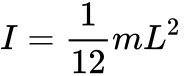
When the axis of rotation passes through the end of the rod and is perpendicular to the rod, the moment of inertia is:
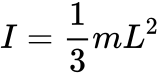
m: the mass of the rod L: the length of the rod
Moment of Inertia of a Cylinder
When the axis of rotation coincides with the central axis of the cylinder, the moment of inertia is:
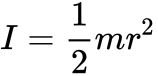
m: the mass of the cylinder r: the radius of the cylinder
Moment of Inertia of a Thin Ring
When the axis of rotation passes through the center of the ring and is perpendicular to the ring surface, the moment of inertia is:
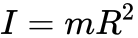
When the axis of rotation passes through the edge of the ring and is perpendicular to the ring surface, the moment of inertia is:
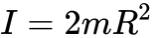
When the axis of rotation lies along a diameter of the ring, the moment of inertia is:
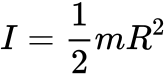
m: the mass of the thin ring R: the radius of the thin ring
Moment of Inertia of a Thin Disk
When the axis of rotation passes through the center and is perpendicular to the disk surface, the moment of inertia is:
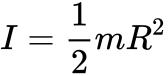
When the axis of rotation passes through the edge and is perpendicular to the disk surface, the moment of inertia is:
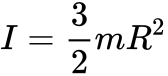
m: the mass of the thin disk R: the radius of the thin disk
Moment of Inertia of a Hollow Cylinder
When the axis of rotation coincides with the symmetry axis of the hollow cylinder, the moment of inertia is:
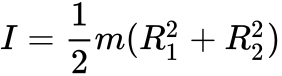
m: the mass of the hollow cylinder R1 and R2: the inner and outer radii of the hollow cylinder, respectively
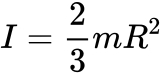
Moment of Inertia of a Spherical Shell
When the axis of rotation passes through the center of the spherical shell, the moment of inertia is:
When the axis of rotation is tangent to the spherical shell, the moment of inertia is:
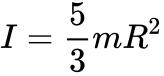
m: the mass of the spherical shell R: the radius of the spherical shell
Moment of Inertia of a Solid Sphere
When the axis of rotation passes through the center of the sphere, the moment of inertia is:
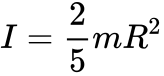
When the axis of rotation is tangent to the sphere, the moment of inertia is:
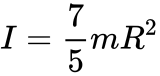
m: the mass of the sphere R: the radius of the sphere
Moment of Inertia of a Cube
When the axis of rotation passes through the center of the cube, the moment of inertia is:
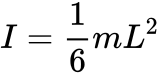
When the axis of rotation lies along an edge of the cube, the moment of inertia is:
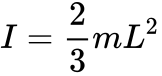
When the axis of rotation lies along a diagonal of the cube, the moment of inertia is:
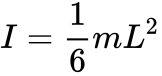
m: the mass of the cube L: the side length of the cube
Moment of Inertia of a Rectangular Cuboid
When the axis of rotation passes through the center of the cuboid, the moment of inertia is:
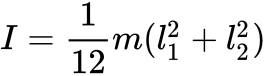
m: the mass of the cuboid l1 and l2: the lengths of the two sides of the rectangle perpendicular to the axis of rotation