First, let's review the basic working principle of a stepper motor.
Like all motors, a stepper motor consists of a stator and a rotor. The stator features tooth-like poles wound with coils, while the rotor is either a permanent magnet or a soft iron core with salient poles (as in variable reluctance stepper motors).
A stepper motor operates by sequentially energizing its stator phases. The current flowing through each coil generates a magnetic field, and the rotor aligns itself with that field. By applying voltage to the phases in a defined sequence, the rotor advances by a fixed step angle per phase transition, ultimately reaching the target position.
As shown in the figure below, when coil A is energized it generates a magnetic field, and the rotor aligns with that field. When coil B is then energized, the rotor rotates clockwise to align with the new magnetic field.
Note: The 60° rotation shown in the diagram is a simplified illustration intended for conceptual understanding only. A typical 2-phase stepper motor has a much smaller step angle (e.g., 1.8° or 0.9° per full step).
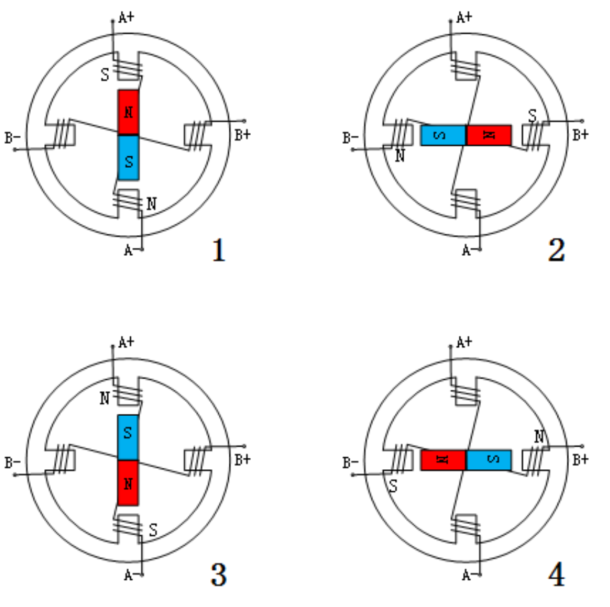
The motor operates by energizing its coils in a specific order. This sequential energization pattern is known as the stepping (or commutation) sequence, as illustrated in the figure above.
In a 2-phase stepper motor, the driver controls the current flowing through each phase independently. Regardless of the stepping mode — whether full-step, half-step, or microstepping — the rated current specified for the motor refers to the maximum current per phase. Therefore, the driver's current setting should match the motor's rated phase current. There is no need to set it to twice the rated current.