Absolute encoders and incremental encoders are two common types of rotary encoders used in motion control and automation. Their primary difference lies in how they output position data. Understanding this distinction is essential for selecting the right encoder for your application.
Absolute Encoder
An absolute encoder outputs a unique digital code for every angular position of the shaft. This means that each position has its own distinct code, so the encoder always knows its exact position immediately upon power-up—no homing or reference move is required. Even after a power loss, the absolute position is retained and reported as soon as power is restored.
The main advantage of an absolute encoder is its ability to provide accurate, real-time absolute position without cumulative error. However, because each position requires a unique code, absolute encoders typically use more data bits and can be more complex and costly than incremental encoders.
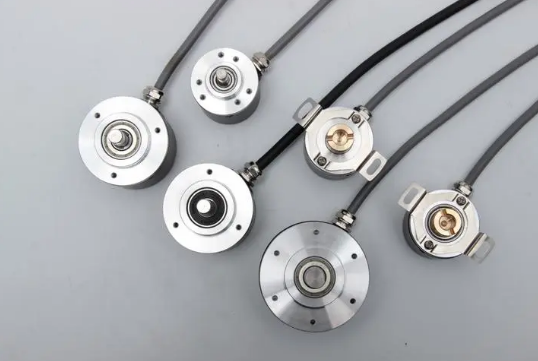
Incremental Encoder
An incremental encoder, by contrast, outputs a series of pulses as the shaft rotates. These pulses indicate relative movement—how far and in what direction the shaft has turned—but do not convey absolute position. To determine position, a counter must track the pulses from a known starting point. If power is lost, the position information is lost and the system must perform a homing routine to re-establish a reference point.
The advantage of an incremental encoder is its simpler design, lower cost, and straightforward signal output. However, because it relies on counting pulses from a reference point, it is susceptible to cumulative positioning errors if pulses are missed or if the reference is lost.
Choosing Between Absolute and Incremental Encoders
The choice depends on your application requirements. If your system needs to know its exact position immediately after power-up and cannot afford the downtime of a homing routine, an absolute encoder is the better choice. If your application is cost-sensitive, does not require immediate position knowledge after power-up, and can accommodate a homing routine, an incremental encoder is a practical and economical option. In some cases, the strengths of both encoder types can be combined to meet specific system requirements.