A linear motor is essentially a stepper motor integrated with a lead screw and nut assembly. In this mechanism, the screw threads and nut threads do not mesh perfectly—a slight gap remains between the mating flanks. This gap is called backlash. Because screw threads typically use a V-shaped profile, this geometry inherently introduces backlash. Backlash between the screw and nut can reduce clamping rigidity, increase the likelihood of loosening, and even lead to thread damage.
The magnitude of the backlash depends on the screw type, diameter, and lead. STEPPERONLINE linear motor screws are available in two categories: trapezoidal screws and ball screws. The backlash characteristics of each type are described below.
Trapezoidal Screws
The backlash of a trapezoidal screw is typically 0.1–0.2 mm, provided the ratio of screw diameter to lead is less than 1. As the lead increases, controlling backlash becomes more difficult. Anti-backlash nuts are commonly used to address this issue.
Ball Screws
Ball screws are known for their high precision and high transmission efficiency, so their inherent backlash is very small and can often be neglected. Backlash can be further reduced by increasing the preload, which is achieved by adjusting the ball size between the nut and the screw.
Eliminating Backlash with an Anti-Backlash Nut
The most effective way to eliminate backlash is to replace the standard nut with an anti-backlash nut. An anti-backlash nut removes the gap between the screw and nut, reducing backlash to a theoretical 0 mm. This improves clamping rigidity and extends thread life.
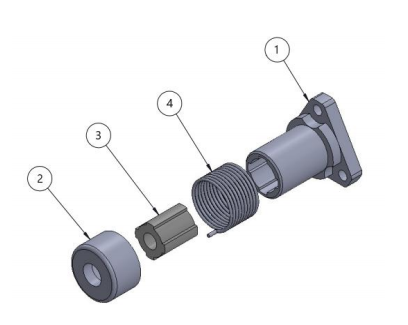
The image above shows a torsion-spring anti-backlash nut, the most widely used type today. Virtually all STEPPERONLINE linear motors can be configured with this anti-backlash nut. It contains internal pressure cores and a spring. When an external force is applied, the spring deforms; the resulting elastic force eliminates play between the threads, allowing the nut to engage the screw more securely.