1. Self-Locking of Worm Gearboxes
Self-locking in a worm gearbox occurs when the tangential force exerted by the worm wheel on the worm is insufficient to overcome friction at the contact surface. As a result, the worm wheel cannot back-drive the worm.
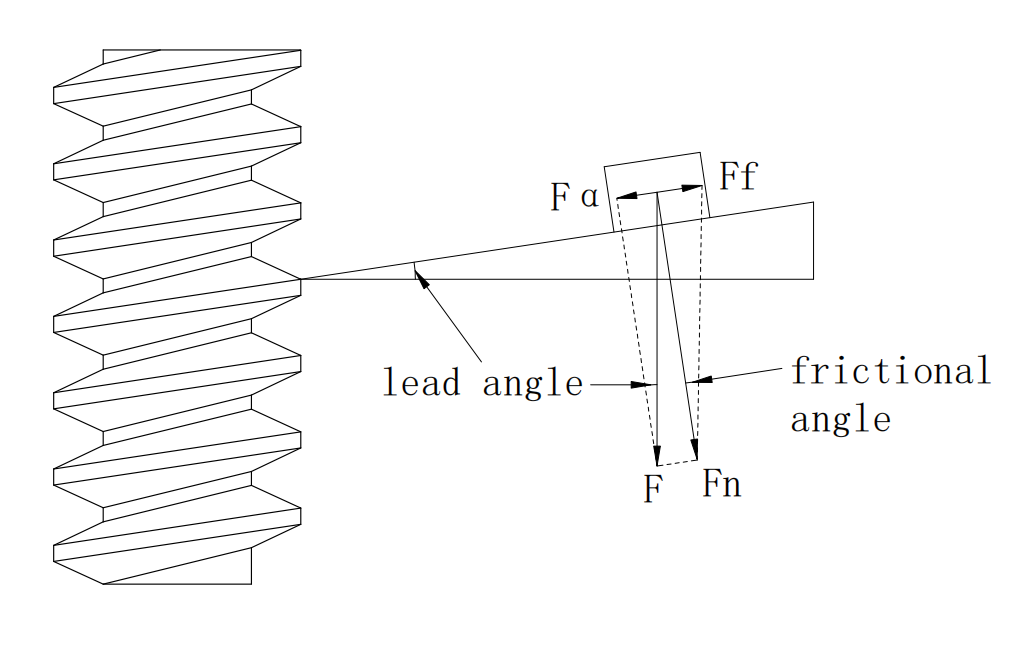
As shown in the figure above, when the lead angle is smaller than the friction angle, Fα is always smaller than the friction force Ff. Under this condition, the worm is in a self-locking state and cannot be back-driven.
When the friction angle remains constant, a smaller lead angle makes self-locking more likely. In general, the higher the reduction ratio of a worm gearbox, the smaller the lead angle of the worm. Therefore, worm gearboxes with high reduction ratios are typically self-locking.
Our worm gearboxes with a reduction ratio of 40:1 or above generally exhibit self-locking behavior under typical operating conditions. However, self-locking performance may vary depending on factors such as lubrication, temperature, and load conditions. For safety-critical applications, additional braking mechanisms are recommended. For more details, please refer to this article: Self-locking of Worm Gear.
In contrast, planetary gearboxes use a planetary gear train for power transmission and lack the friction mechanism required for self-locking. Therefore, planetary gearboxes are generally not self-locking and can be back-driven.
2. Other Methods to Prevent Back-Driving
Because the efficiency of self-locking worm gearboxes is generally low, alternative methods can be considered to prevent back-driving when the reverse load is relatively small.
a. Using the Detent Torque of the Stepper Motor
When the stepper motor is not energized, a small detent torque is present due to the magnetic attraction between the rotor's permanent magnets and the stator teeth. This torque is amplified by the gearbox and, combined with the mechanical friction of the system, can resist back-driving to a limited extent. However, because the detent torque is very small, the reverse load it can withstand — even after gearbox amplification — remains minimal.
b. Using the Holding Torque of the Stepper Motor
When the stepper motor is energized, the stator coils generate a magnetic field that attracts and locks the rotor's permanent magnets, preventing the rotor from turning. This locking torque is called the holding torque, which is typically the torque value specified on the stepper motor's datasheet.
The holding torque, transmitted through the gearbox, can resist back-driving with a significantly greater force and can withstand larger loads. However, this torque is still limited. Once the load exceeds the motor's capacity, the gearbox will still be back-driven.
Summary
In summary, back-driving can be prevented by leveraging either the gearbox's inherent self-locking mechanism or the motor's torque characteristics. However, the motor's ability to resist back-driving is limited. In terms of back-driving resistance:
Self-locking > Holding torque > Detent torque