This article explains the differences between the Lead Angle Algorithm and the Vector Mode Algorithm configured in Parameter 24 (Operating Mode) of the CL86Y driver firmware, along with recommended use cases for each mode.
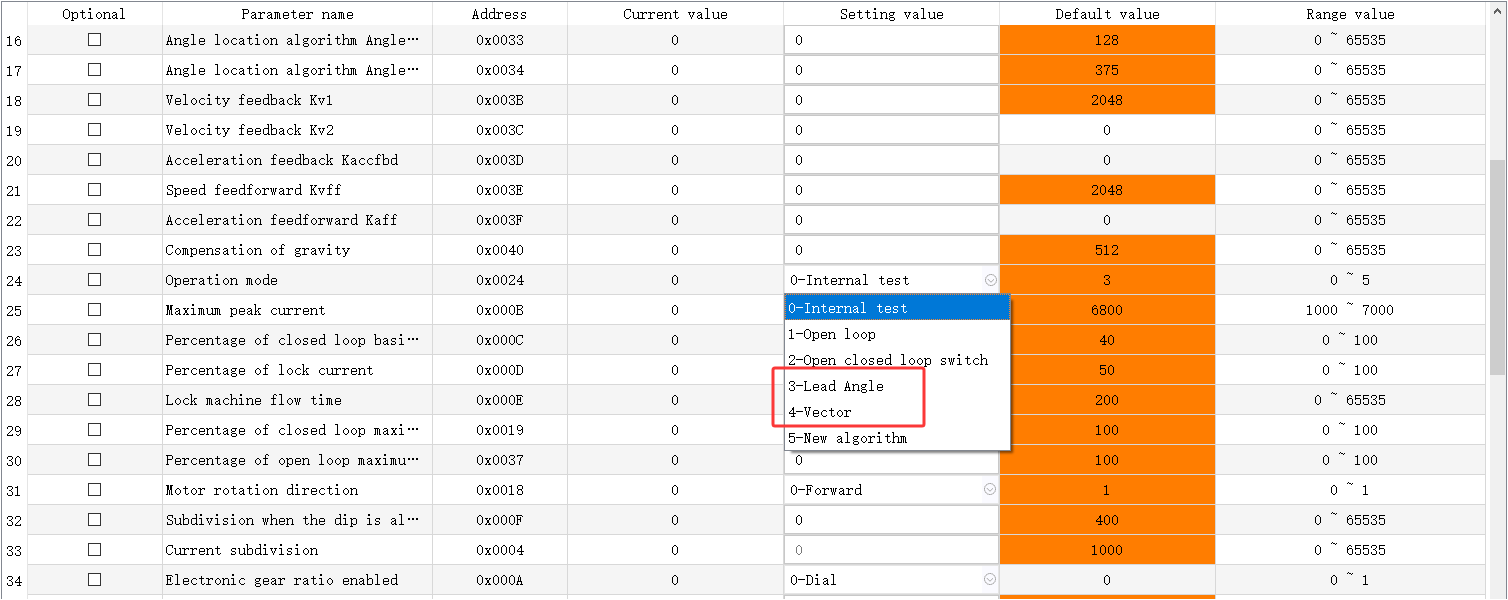
1. Control Logic and Characteristics
| Algorithm | Control Logic and Characteristics |
|---|---|
| Lead Angle Algorithm | Operates as an open-loop pulse drive with encoder-based position compensation. It adjusts the current phase advance angle to synchronize the stator current with rotor motion, using preset phase advance values. |
| Vector Mode Algorithm | Based on Field-Oriented Control (FOC). It decomposes the three-phase current into independent excitation (flux) and torque components, enabling precise control of current magnitude and direction while decoupling torque from the magnetic field. |
2. Comparative Analysis and Typical Application Scenarios
| Aspect | Lead Angle Algorithm | Vector Mode Algorithm |
|---|---|---|
| Advantages | High power output at medium-to-high speeds; Fast dynamic response; High torque in the 800–1200 RPM range | Lower motor temperature rise; Reduced operational noise; High control precision, especially at low speeds |
| Disadvantages | Higher motor temperature rise; Increased operational noise; Relies on encoder feedback for position-loop compensation; Poor anti-interference performance at low speeds, prone to jitter | Reduced holding torque performance under stall conditions; Lower power output at medium-to-high speeds compared to the Lead Angle Algorithm; More complex parameter tuning; Slightly slower dynamic response |
| Typical Applications | Applications requiring rapid response, quick start/stop cycles, and medium-to-high speed operation (800–1200 RPM) with high power output. Examples: Pick-and-place machines requiring fast acceleration/deceleration cycles; Conveyor systems requiring high torque at medium speeds; Power tools (e.g., impact drills, cutters) requiring instant high torque at high speeds; Fluid machinery (e.g., fans, pumps) prioritizing high flow output at approximately 1000 RPM with simplified control logic | Applications requiring low motor temperature rise, quiet operation, and medium-to-low speed operation (below 800 RPM). Examples: CNC machine spindle control with constant-torque cutting at low speeds and current decoupling for precision; Medical equipment (e.g., CT scanners) requiring low noise (<50 dB) and high-precision positioning with sinusoidal current drive to minimize vibration; Textile machinery tension control with real-time load response and closed-loop regulation to maintain yarn tension fluctuation within ±1% |
3. Legacy CL57Y Driver — Operating Mode Selection
For the legacy CL57Y driver, the operating mode is selected via DIP switch SW3:
- SW3 OFF — Point Mode (equivalent to the Lead Angle Algorithm)
- SW3 ON — Track Mode (equivalent to the Vector Mode Algorithm)
Note: "Point Mode" and "Track Mode" are legacy terms used in earlier firmware versions of the CL57Y. They correspond to the Lead Angle Algorithm and Vector Mode Algorithm, respectively.