I. What Is a Filter?
A filter is an electronic component that extracts or suppresses specific frequency components from a complex signal.
II. Why Do Servo Motors Need Filters?
Servo drives use Pulse Width Modulation (PWM) technology to control the motor, outputting a voltage in the form of a series of high-frequency switching pulses. This creates two main issues:
- Common-Mode Noise: High-frequency noise generated between the motor phase lines and the ground line.
- Differential-Mode Noise: High-frequency noise generated between the motor phase lines themselves.
These types of noise can lead to the following problems:
- Motor Cogging, Abnormal Noise, and Overheating: High-frequency noise results in distorted current waveforms, causing the motor to vibrate slightly instead of rotating smoothly. This generates excess heat and audible whining.
- Encoder Interference: Noise can interfere with the precise encoder feedback signals, causing position errors and potentially triggering drive alarms.
- Interference with Other Equipment: High-frequency noise generated by the servo system can propagate through power lines or radiate through the air, affecting other sensitive equipment (such as sensors and PLCs) on the same electrical network.
III. Filter Selection
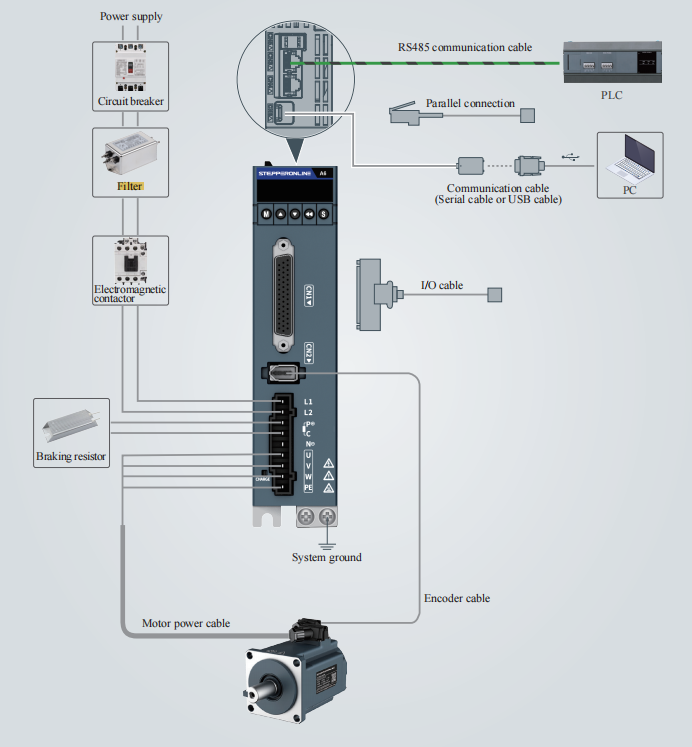
As shown in the diagram, the filter compatible with our A6 servo motors is an input-side filter designed to suppress both common-mode and differential-mode noise. Its primary functions include:
- Preventing transient pulses and noise from the power grid from affecting the normal operation of the drive.
- Blocking the high-frequency switching noise generated by the drive from feeding back into the power grid, thereby meeting Electromagnetic Compatibility (EMC) regulatory requirements.
When selecting a filter model, pay attention to the following key parameters:
- Rated Voltage: Must match the drive's input power supply voltage.
- Rated Current: Should be greater than or equal to the drive's maximum continuous input current.
- EMC Compliance Level: Select a grade that complies with the standards of the target market.
- Connection Method: Ensure compatibility with the wiring of the power supply and the drive.
During installation, the filter should be placed between the power supply and the drive, as close to the power supply as possible, to reduce noise interference and facilitate subsequent maintenance. For equipment requiring grounding, the filter's ground wire must be connected to the equipment's ground line to ensure an effective ground connection.