During equipment maintenance or upgrades, a common issue arises: after a brushless motor fails and is replaced with a new one that appears identical in model, size, voltage, and power rating, the equipment still fails to operate correctly. The new motor may exhibit severe jerking during startup, weak rotation, abnormal noise, or simply refuse to move at all.
After ruling out common issues such as wiring errors or drive parameter mismatches, a frequently overlooked cause is the Hall sensor phase angle—which may be either 60 degrees or 120 degrees. This angular mismatch can cause the entire drive system to malfunction.

The Difference Between "60-Degree" and "120-Degree" Configurations
The terms "60-degree" and "120-degree" refer to the electrical angle between the rising edges of adjacent Hall sensor output signals in the commutation sequence.
When you receive a new brushless motor, you can determine whether the Hall angle is 60 or 120 electrical degrees by measuring the three Hall signals and analyzing their phase relationships.
- In a 60-degree configuration: The waveform of the three Hall sensor outputs shows a 60-degree phase shift between the rising edges of adjacent signals in the commutation sequence.
- In a 120-degree configuration: The waveform of the three Hall sensor (H1, H2, H3) outputs shows a 120-degree phase shift between the rising edges of adjacent signals. This is the most common and widely adopted configuration.
The diagram below provides a simplified reference waveform.
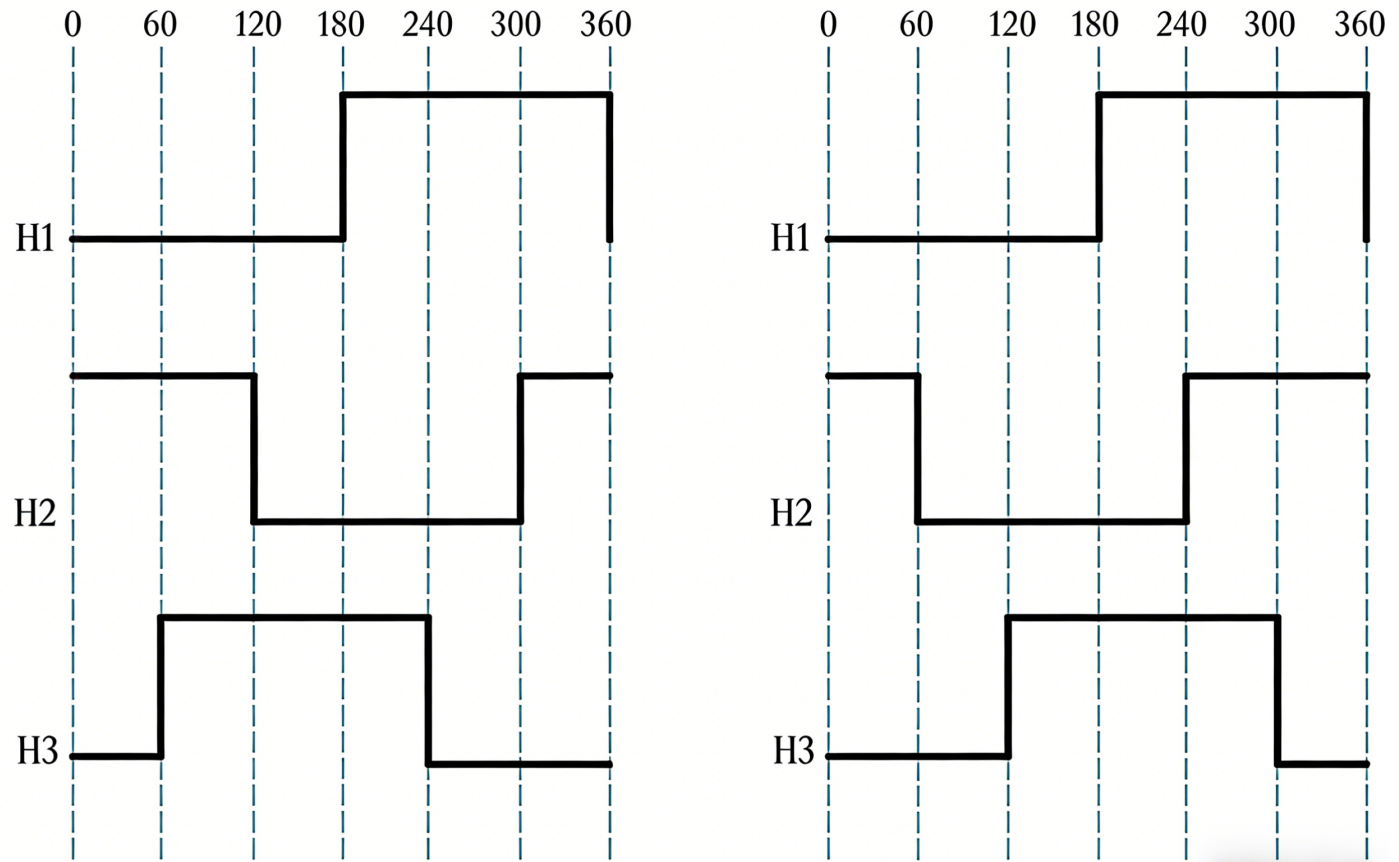
As shown in the left waveform, the rising edge of H1 lags that of H2 by 120 electrical degrees, H2 lags H3 by 120 degrees, and H3 lags H1 by 120 degrees. This confirms that the three Hall sensors are installed at 120-degree intervals.
As shown in the right waveform, the rising edge of H1 lags that of H2 by 60 electrical degrees, H2 lags H3 by 60 degrees, and H3 lags H1 by 240 degrees (equivalently, H3 leads H1 by 120 degrees). This pattern confirms a 60-degree Hall sensor configuration.
Solution:
Our standard off-the-shelf brushless drives only support 120-degree Hall sensors. If you require a drive compatible with 60-degree sensors, please contact our technical support team to assess whether a custom solution is feasible.
Technical Warning:
While some online resources suggest physically repositioning Hall sensors or using jumper wires to "convert" the angle, these methods require extremely high precision and professional equipment. For the vast majority of industrial applications, we strongly advise against attempting such modifications, as they are highly prone to failure and can introduce unreliable operation.