Insulation Class and Temperature Rise
Motor insulation classes are categorized based on the maximum allowable operating temperature of the insulation materials used. Common classes include A, E, B, F, and H. The allowable limit temperature reflects the heat resistance of the insulation material. Insulation materials are classified into Class A, Class E, Class B, Class F, and Class H, with maximum allowable temperatures of 105 °C, 120 °C, 130 °C, 155 °C, and 180 °C, respectively, as shown below.
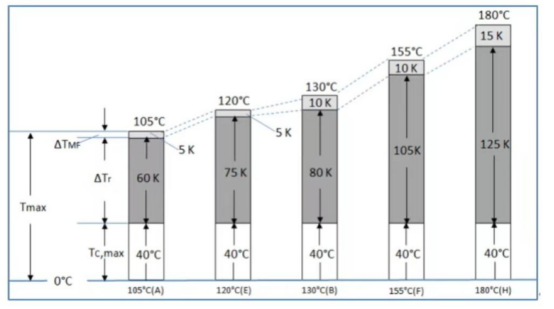
When a motor uses Class B insulation, the temperature rise limit of the stator winding (measured by the resistance method) must not exceed 80 K. When a motor uses Class H insulation, the temperature rise limit of the stator winding must not exceed 125 K. StepperOnline offers custom high-temperature motors with insulation ratings up to and including Class H. Contact our engineering team for specifications and lead times.
Duty Types of Electric Motors
| Duty Type | Name | Description |
|---|---|---|
| S1 | Continuous duty | The motor operates at a constant load long enough to reach thermal equilibrium. This duty type is typically suited for continuous-load applications such as fans and conveyor belts. |
| S2 | Short-time duty | The motor runs under a constant load for a specified duration. Before reaching thermal equilibrium, the motor is shut down long enough to cool to within 2 K of the coolant temperature. In this duty type, the running time is very short, and the heating period is much shorter than the cooling period. Motors with this duty type are commonly found in cranes, household appliance drives, and valve actuators. |
| S3 | Intermittent periodic duty | The motor operates through a sequence of identical duty cycles, none of which reach thermal equilibrium. Each cycle consists of a constant-load running period followed by a standstill period with power off. The starting current in each cycle has no significant effect on temperature rise. Each cycle typically has a duration of 10 minutes, and the cyclic duration factor is normally one of the following standard values: 15%, 25%, 40%, or 60%. Motors with this duty type are commonly used in stamping and drilling machines. |
| S4 | Intermittent periodic duty with starting | The motor operates through a sequence of identical duty cycles. Each cycle includes a starting period that significantly affects temperature rise, a constant-load running period, and a standstill period with power off. This duty type is similar to S3 but adds a starting phase, so the moment of inertia of the motor load (i.e., the motor's acceleration capability) must be specified. Motors with this duty type are widely used in metal-cutting machines, drilling machines, and mining hoists. |
| S5 | Intermittent periodic duty with electric braking | The motor operates through a sequence of identical duty cycles. Each cycle includes a starting period, a constant-load running period, a rapid electric braking period, and a standstill period with power off. As with S4, the moment of inertia of the motor load must be specified. All periods are too short for the motor to reach steady-state temperature. Motors with this duty type are commonly used in billet rolling mills, robot drives, and mining hoists. |
| S6 | Continuous operation with intermittent load | The motor operates through a sequence of identical duty cycles. Each cycle consists of a constant-load running period followed by a no-load running period, with no standstill. The operating cycle equals load plus no-load operation. This duty type is similar to S3 and is common in pressing and cutting machines. |
| S7 | Continuous operation with electric braking | The motor operates through a sequence of identical duty cycles. Each cycle includes a starting period, a constant-load running period, and a rapid electric braking period, with no standstill. This duty type extends S6 by adding a starting phase and an electric braking phase to each cycle. Typical applications include cotton gins and certain types of winding machines. |
| S8 | Continuous operation with periodic changes in load and speed | The motor runs through a sequence of identical duty cycles, each consisting of operation at a constant load and a given speed, followed by operation at other constant loads and speeds. There are no rest periods. |
| S9 | Duty with non-periodic load and speed variations | A non-periodic duty type in which the load and speed vary within the allowable operating range. This duty type may include frequent overloads that can exceed full load. It is relatively complex and is often defined based on actual operating conditions, such as in wind power generation. |
| S10 | Duty with discrete constant loads and speeds | This duty type includes no fewer than four discrete load values (or equivalent loads), which may include no-load operation and standstill. Thermal equilibrium is reached under each load condition (including no-load or standstill). Within a single duty cycle, the minimum load value may be zero (i.e., no-load or standstill). Compared with S8, this duty type can be viewed as consisting of multiple constant-load segments with various loads and durations, but excluding acceleration and deceleration phases. |