Stepper motor performance depends not only on the motor itself but also on the drive and control methods used. When selecting a stepper motor, you should evaluate both factors. Stepper motors can be driven in two ways: constant-voltage drive and constant-current drive. Most stepper drives on the market today use constant-current drive. Constant-voltage drive is rarely used because it produces high copper losses (I²R losses).
The figure below shows the schematic of a constant-current chopper drive. When the target drive current is set to I₀, the chopper regulates the winding current as follows:
- If the winding current exceeds I₀, the applied voltage V is switched off, allowing the current to decrease.
- If the winding current falls below I₀, voltage V is applied again, allowing the current to rise back toward I₀.
This cycle repeats continuously, regulating the winding current at the target value I₀.
At low speed, if the motor is not driven by a constant-current chopper, the winding current can exceed the motor's rated current, causing excessive temperature rise and potentially burning out the motor.
At high speed, however, the voltage on-time for each phase winding may be shorter than t₀ (as shown in the figure below). In this case, the supply cannot deliver the target current I₀ before the next step begins, and the chopper loses its ability to regulate current. The drive then effectively operates in constant-voltage mode.
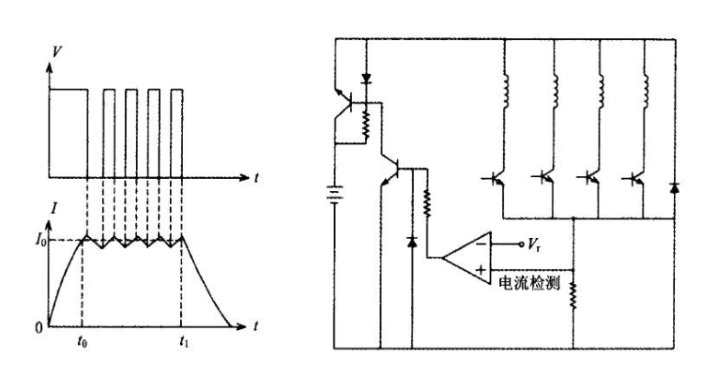
Figure: Current waveform of a constant-current chopper drive. I₀ is the target current; t₀ is the minimum on-time required for the current to reach I₀.