A 6-wire stepper motor is a two-phase motor with center taps. The O+ and O- wires are the center taps of the phase A and phase B windings, respectively. When using a 4-wire (bipolar) driver, you can wire the motor in two ways:
- Unipolar-style connection (center taps unconnected): Leave the O+ and O- (center tap) wires unconnected. Connect only A+, A-, B+, and B- to the driver. In this configuration, the motor behaves similarly to a standard 4-wire (bipolar) stepper motor. This method provides relatively high holding torque and efficiency, but high-speed performance is relatively poor. It is best suited for low-speed, high-torque applications. Because only half of each winding is used in this configuration, the current should be limited to approximately 70% of the motor's rated current to avoid overheating. Please verify this value against your motor's datasheet.
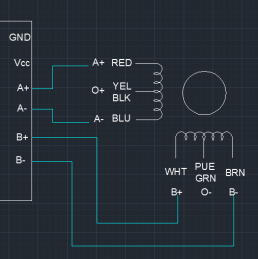
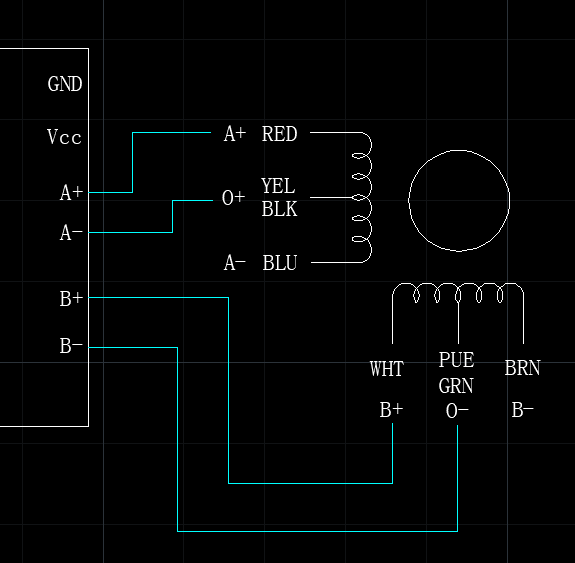
- Half-winding connection (center taps connected): Connect O+ to either A+ or A- (one of the two phase A leads), and connect O- to either B+ or B- (one of the two phase B leads). Refer to the wiring diagram below. This configuration offers better high-speed performance, but because one half of each winding is idle, the holding torque and efficiency will be relatively lower. This configuration is suitable for applications that require relatively high speed. The maximum operating current can be set to the motor's rated current.
Note: When using a 4-wire (bipolar) driver to control a 6-wire motor, the center taps are left unconnected or only partially utilized, which means only part of each winding may be used depending on the wiring configuration. This can result in lower overall efficiency compared to using a driver specifically designed for 6-wire (unipolar) motors. Therefore, when selecting a driver, make sure to consider the motor's rated current and holding torque to ensure proper matching between the motor and the driver.