First, it is important to understand that parameters such as pole count are typically relevant for motors such as AC induction motors and BLDC motors, where the number of pole pairs directly determines their synchronous speed (Speed = 120 × Frequency / Number of Poles). However, does the concept of pole count apply to stepper motors in the same way?
For stepper motors, the parameter of primary concern to the user is the Step Angle – the angle the motor rotates for each input pulse. This angle is determined by the number of phases, the number of rotor teeth, and the excitation mode. Therefore, the "pole count" information of a stepper motor is already encapsulated within this final parameter, the step angle.
Taking the most common two-phase hybrid stepper motor as an example, its structure is representative.
- Stator Pole Count: A standard two-phase hybrid stepper motor has 8 main poles. Each main pole contains multiple small teeth (e.g., 5 teeth). Thus, the total magnetic pole effect of the stator can be viewed as the number of these small teeth.
- Rotor Tooth Count: The rotor has a number of small teeth (e.g., 50 teeth). The rotor consists of a permanent magnet magnetized axially, with one set of teeth acting as N poles and the other set as S poles. The effective number of rotor poles is twice the tooth count on one end.
Step Angle Calculation: Step Angle = 360° / (Number of Phases × Rotor Tooth Count × Steps per Electrical Cycle)
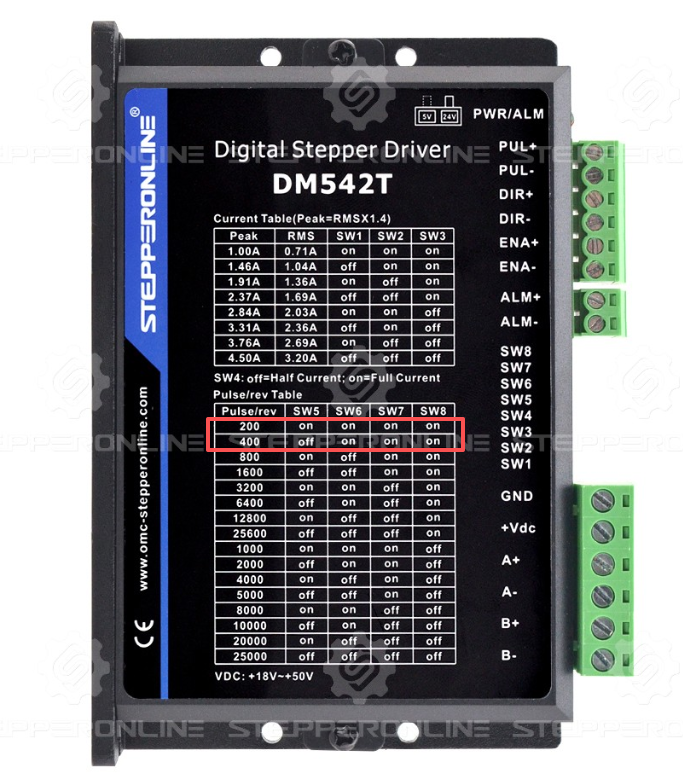
Using the most common 1.8° two-phase stepper motor as an example: Number of Phases = 2 Rotor Tooth Count = 50 In full-step mode (2-phase excitation, 200 steps per revolution): Step Angle = 360° / (2 × 50 × 2) = 1.8° In half-step mode (alternating single-phase and dual-phase excitation, 400 steps per revolution), a 0.9° step angle can be achieved.
Therefore, a rotor with 50 teeth corresponds to 100 magnetic poles. For the common 1.8° two-phase hybrid stepper motor, you can consider its rotor to have 100 magnetic poles (50 pole pairs).
The same logic applies to three-phase stepper motors. Consequently, when selecting a two-phase or three-phase stepper motor, the parameters you should focus on are:
- Step Angle: Determines the motor's resolution (e.g., 1.8°, 0.9°).
- Number of Phases: Determines the type of drive required (e.g., two-phase, three-phase).
- Holding Torque: The load capacity of the motor.
- Current: Determines the output current setting of the drive.