The torque characteristics of a stepper motor are influenced by several factors: the higher the driving voltage, the higher the current; the lower the motor speed, the greater the torque — and the greater the heat generated.
For the same motor, does changing the driving voltage affect its torque output?
We conducted torque tests on the 23HS45-4204S at different voltages, as shown in the figure below:
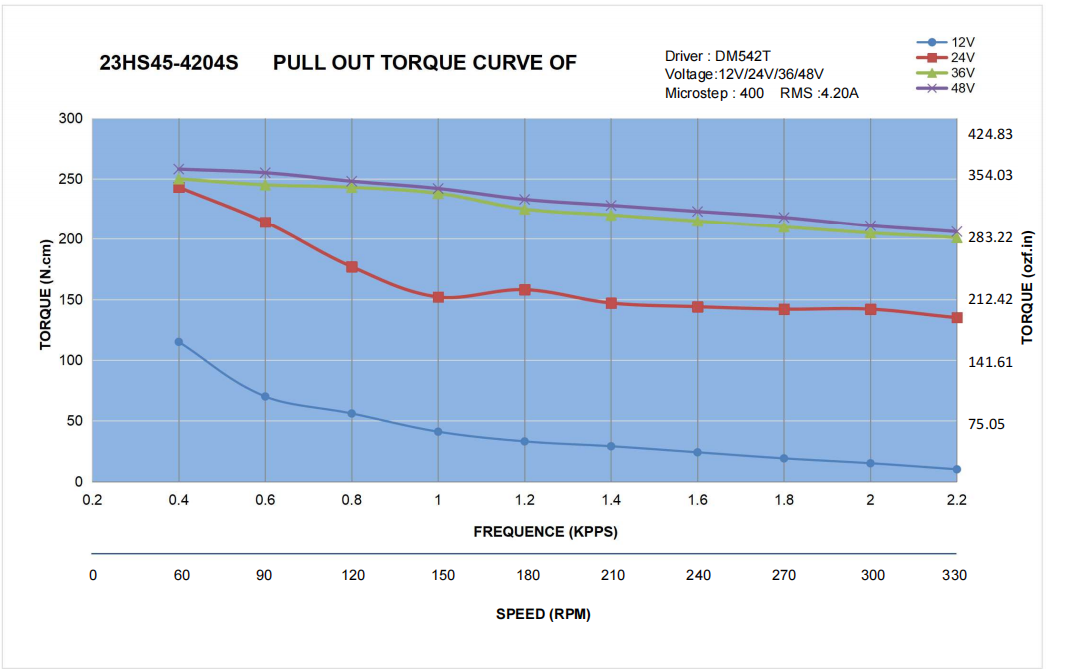
The results show a clear relationship between torque and voltage in a stepper motor. At different voltages, the torque performance varies. Below are some key concepts related to this relationship:
-
Relationship between voltage and torque: The torque of a stepper motor is proportional to the current, and the current is influenced by the applied voltage. As the voltage increases, the current through the motor rises accordingly, resulting in higher torque. However, this relationship is not strictly linear, because the motor's resistance and inductance also affect how the current changes.
-
Torque at low voltage: At lower voltages, the torque output of a stepper motor may be reduced. This is because lower voltage results in less current, which in turn causes the motor to produce less torque. Under these conditions, the stepper motor may not be able to overcome the load resistance, leading to degraded performance.
-
Torque at high voltage: At higher voltages, the torque output of a stepper motor may be greater. This is because higher voltage drives more current through the motor, producing greater torque. However, excessively high voltage may cause the motor to overheat, which can affect its lifespan and operational stability.
-
Optimal voltage: To strike a balance between torque output and motor longevity, it is important to select an appropriate driving voltage. This means choosing the proper voltage based on the motor's rated specifications and the requirements of the application.
In summary, the torque of a stepper motor behaves differently at different driving voltages. When selecting a stepper motor and its corresponding driving voltage, it is essential to fully consider the motor's performance requirements, load conditions, and rated parameters to ensure stable and efficient operation in practical applications.