To understand this, we need to clarify how the torque-speed curve of a stepper motor is plotted and the physical differences between the motor's stationary and rotating states. The image below shows the torque curve for the 24E1K-30 stepper motor.
As shown in the graph, the curve generally starts at approximately 100 RPM. Here are the key points to understand:
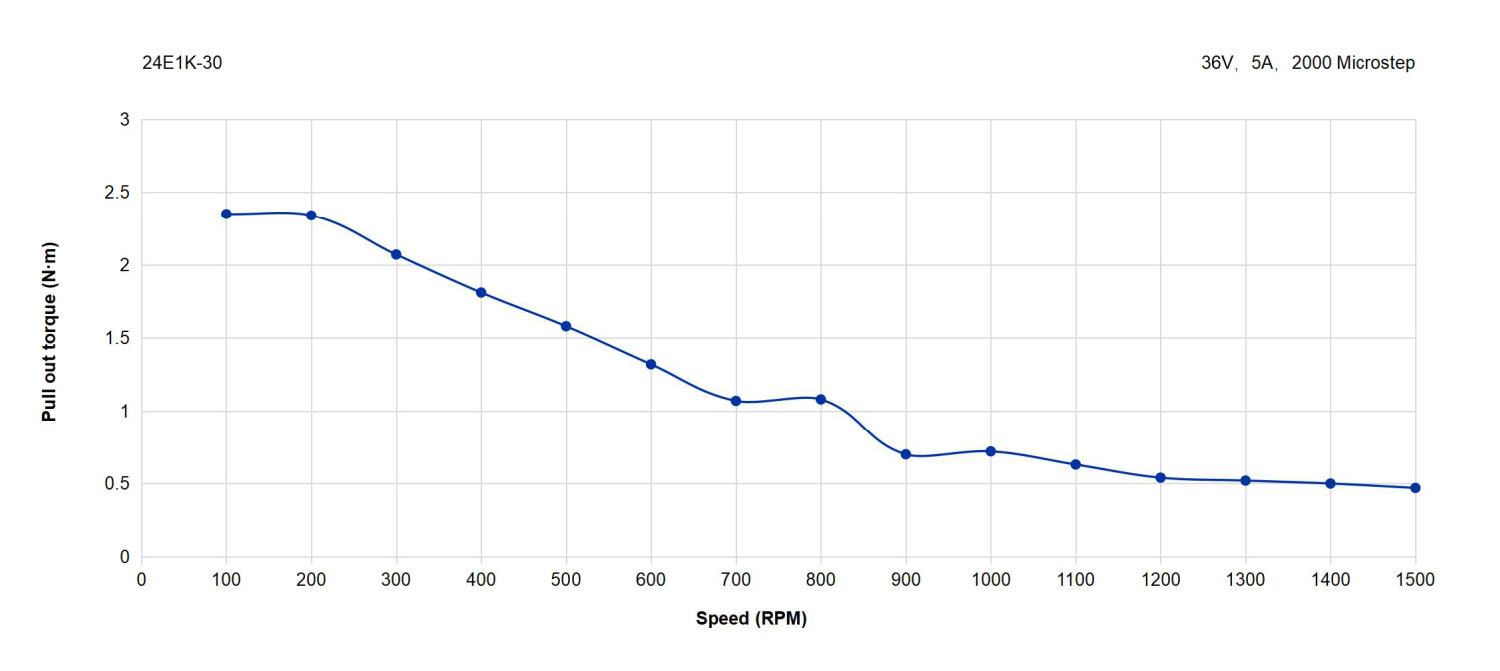
Torque Curve Measurement Method: The torque-speed curve describes the maximum continuous torque the motor can output at various rotational speeds. The term "continuous" is critical here. The standard test method involves running the motor at a fixed speed and then gradually increasing the load until the motor stalls (i.e., loses synchronism and can no longer follow the step commands). This measurement is known as the pull-out torque. The torque value recorded at the point of stalling represents the maximum continuous torque for that speed.
Holding Torque: At zero speed, the motor is in a stationary, energized, and locked state. The maximum torque it can generate in this state is called the Holding Torque. It is the maximum resistance torque you can feel when manually attempting to rotate the rotor while the motor is energized. This value is generally higher than the continuous torque in the low-speed region.
Why the Curve Shows a Small Peak Near Zero Speed: At very low speeds (e.g., near 100 RPM), the back-EMF generated by the motor is minimal, allowing the winding current to reach its rated value more easily. This results in a slightly higher torque output compared to mid-range speeds, creating the small peak visible at the left end of the curve.
Why the Curve Does Not Extend to Zero RPM: At zero speed, the motor is stationary, and its torque output is characterized as Holding Torque—a static property. The torque-speed curve, by definition, describes dynamic performance under rotation, so it does not include the zero-speed point. Because Holding Torque is a static characteristic, it is fundamentally different from the continuous torque measured under dynamic rotating conditions. Therefore, standard practice is to represent the holding torque with a vertical dashed line or a separate data point, while the dynamic torque curve begins plotting from the small peak described above.
Conclusion: At very low speeds, stepper motors are highly susceptible to resonance, making it difficult to measure torque accurately. This is why torque measurement typically starts at around 100 RPM. For more information on speed limits, see this article on maximum and recommended operating speeds for various stepper motor sizes: Max. Motor Speed and Recommend Motor Speed | Help Center