A brushless motor contains three phase windings, each with two terminals, for a total of six terminals. During wiring, however, only three lead wires (U, V, and W) are used, so the phase windings must be interconnected. There are two common connection methods: delta connection and star (Y) connection.
- What are delta connection and star (Y) connection?
Delta connection: The end of each phase winding is connected to the start of the next phase winding in sequence, forming a closed loop. The three junction points serve as the lead-out terminals. The resulting wiring pattern resembles the Greek letter delta (Δ), hence the name.
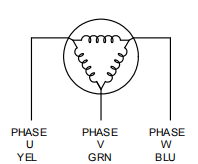
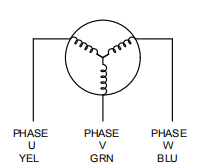
Star (Y) connection: One end of each of the three phase windings is joined together at a common neutral point, while the other ends serve as the lead-out terminals (U, V, W). The resulting wiring pattern resembles a star or the letter Y, hence the name.
- Differences between delta connection and star (Y) connection
a. Delta connection
In a delta-connected motor, the line voltage equals the phase voltage, and the line current is √3 times the phase current. This configuration provides higher starting torque and improved performance. The drawback is a higher starting current.
b. Star (Y) connection
In a star-connected motor, the line current equals the phase current, and the line voltage is √3 times the phase voltage. This configuration results in lower starting current, and the voltage across each phase winding is lower than the line voltage by a factor of √3. The drawback is lower output power and torque compared to the delta connection.