The primary function of a braking resistor is to dissipate the excess regenerative energy generated by a servo motor during rapid braking or deceleration. This maintains DC bus voltage stability and protects the drive from overvoltage damage.
For the servo motors currently offered:
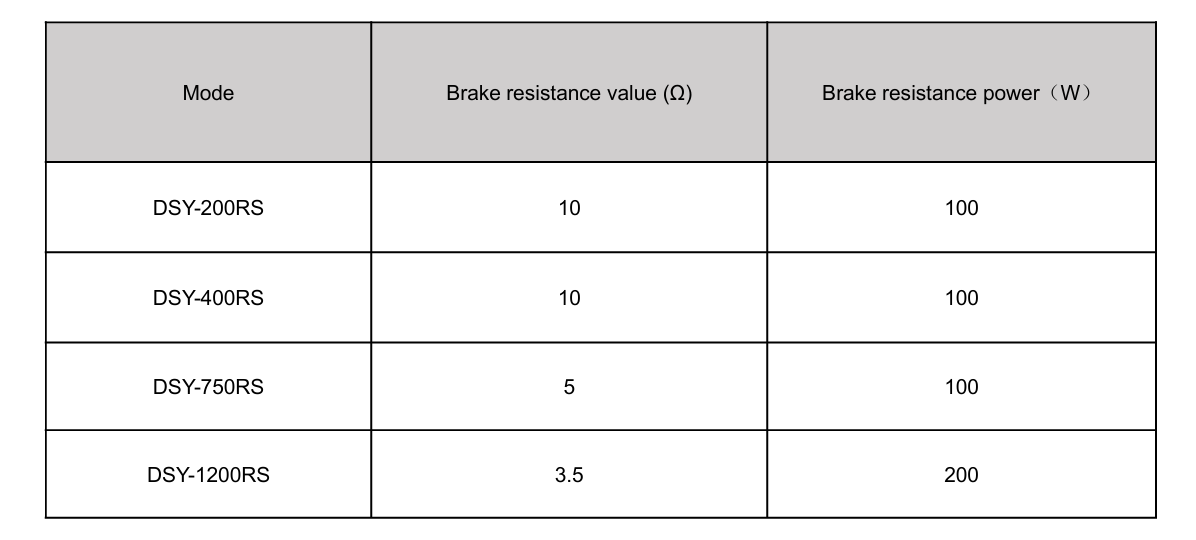
- The DSY series is not equipped with a built-in braking resistor and requires an external braking resistor. The resistor specifications are shown in the figure below.
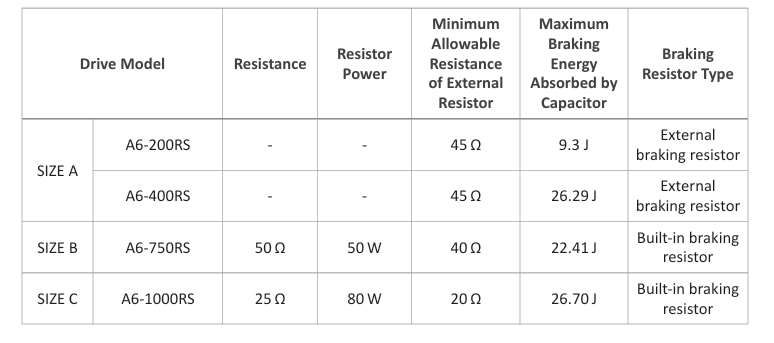
- The A6 series (400 W and below) is not equipped with a built-in braking resistor. The resistor specifications are shown in the figure below.
- The T6 series 100 W model is not equipped with a built-in braking resistor. The resistor specifications are shown in the figure below.

- The T6-100RS allows a minimum resistance of 50 Ω, with a recommended minimum power rating of 50 W.
Key Points:
-
Essential for Rapid Start-Stop Applications: In applications requiring rapid acceleration and deceleration, a braking resistor should be installed. If a braking resistor cannot be used, the acceleration and deceleration times must be set to sufficiently long values. Under high-load conditions with rapid starts and stops, the motor acts as a generator and feeds significant regenerative energy back into the drive, which must be dissipated by the braking resistor.
-
Stepper Motor Considerations: Stepper motor drivers typically do not include a braking resistor circuit. As a result, in high-load applications with rapid acceleration or deceleration, the regenerative energy generated by the motor cannot be effectively dissipated, which may lead to overvoltage faults. Users should avoid aggressive deceleration settings in such applications.
-
Do Not Disable the Drive While the Motor Is Running: Do not abruptly remove the servo-enable signal or cut power to the drive while the motor is running at speed. In systems without a braking resistor, the motor's rotational inertia causes it to continue spinning and generate regenerative energy that cannot be dissipated, potentially leading to overvoltage damage to the drive. Even in systems equipped with a braking resistor, this practice should be avoided.
Conclusion: In high-dynamic-response servo applications, correctly selecting and configuring a braking resistor is essential to ensure stable system operation and prevent drive damage.