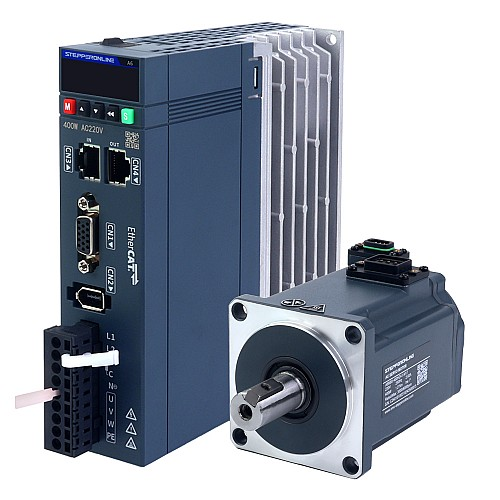
The A6 series is a high-performance servo product line launched by STEPPERONLINE. It efficiently meets the diverse requirements of automated production applications, offering an excellent balance between performance and cost. The A6 series supports pulse, Modbus RS485, EtherCAT, and PROFINET control.
This series is available in three variants:
● A6-RS (supports pulse and Modbus RS485) ● A6-EC (supports EtherCAT) ● A6-PN (supports PROFINET)
The A6-RS and T6-RS servo motor kits are very similar in functionality. Below is a detailed comparison of their differences across several key parameters:
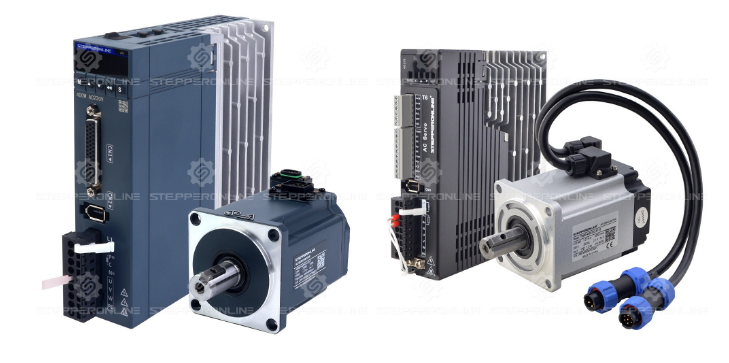
- Control Method
The A6-RS supports pulse control (maximum input frequency 4 MHz), RS485 communication control, and analog voltage control. The A6-EC supports EtherCAT communication control, and the A6-PN supports PROFINET communication control. In contrast, the T6 series supports only pulse control (maximum input frequency 500 kHz) and RS485 communication control.
The A6 series offers more diverse control methods, greater flexibility, and a higher pulse input frequency than the T6.
- Encoder
The A6 series uses a 17-bit single-turn absolute encoder. It can also function as a multi-turn absolute encoder when used with the AS7-C-ENC075-BAT-3.0 encoder cable with battery box.
The T6-RS series is available with two encoder options: a 17-bit incremental magnetic encoder and a 23-bit absolute magnetic encoder. Please note that the 23-bit encoder can function as an absolute encoder only when used with the CEAST1M5-2 encoder cable with battery box.
- Commissioning Cable and Software
Regarding commissioning cables, the A6 uses a standard USB Type-C data cable. This type of cable is widely available, so STEPPERONLINE does not include one with the product. We recommend referring to the following article when selecting a Type-C cable: https://help.stepperonline.com/en/article/how-to-choose-the-correct-type-c-debugging-cable-1q6lhtc/?bust=1727320036304
The T6 uses a dedicated RS232-to-RJ45 commissioning cable. Because this is a custom cable, STEPPERONLINE provides it free of charge with the product.
Regarding configuration software, the A6 series supports one-click auto-tuning, while the T6 does not support this feature. Additionally, the A6 configuration software offers a more intuitive interface layout and a better overall user experience.
- Digital Input and Output Signals
The A6 provides 8 DI input points and 5 differential DO output points, allowing flexible assignment of various functions (such as status display, JOG operation, etc.). The T6 input signals support similar functions, but the T6 has only 4 DI input points, 2 single-ended DO outputs, and 1 differential DO output point. As a result, the A6 offers greater flexibility in function allocation.
- Storage and Operating Environment
A6: Storage temperature −40 °C to +70 °C; operating ambient temperature 0 °C to +55 °C (performance is derated by approximately 10% for every 5 °C increase above 45 °C). T6: Storage temperature −20 °C to +80 °C; operating ambient temperature 0 °C to +55 °C.
Each series has its advantages depending on the storage temperature requirements of your application.
In summary, the A6 series, as STEPPERONLINE's latest AC servo product line, offers numerous advantages over the T6. We hope this article helps you make an informed decision. If you have any further technical questions, please feel free to contact us.