Many people mistakenly believe that increasing microstepping directly increases the torque of a stepper motor. In fact, microstepping itself does not generate additional torque. However, by optimizing the motor's operating conditions, it can significantly enhance the motor's effective output torque and overall performance.
The chart below shows a comparison of the torque curves for our model 34IP65-45 motor operating at 400 pulses/rev (2 microsteps/step) and 2000 pulses/rev (10 microsteps/step).
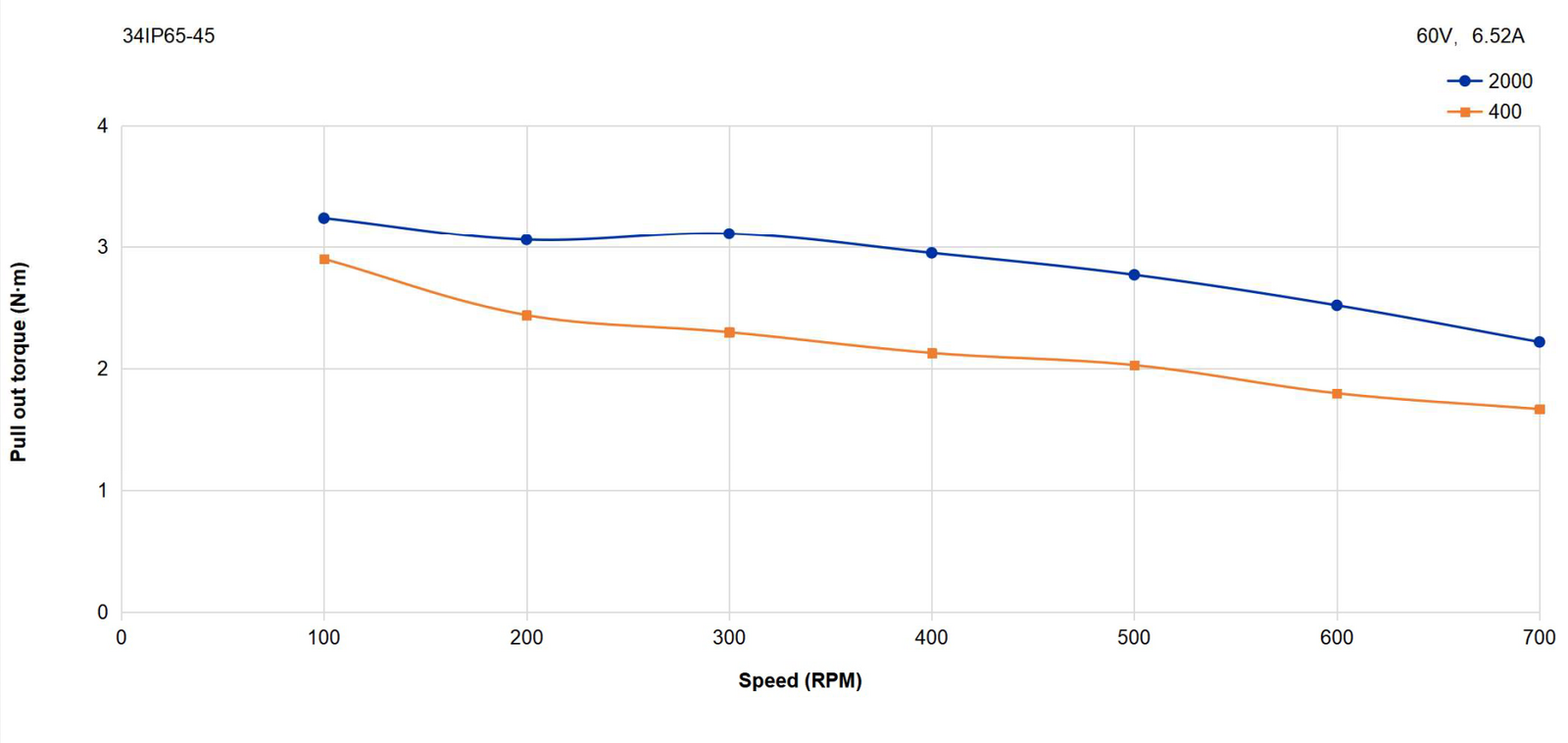
I. Core Conclusion: Microstepping Does Not Increase Holding Torque, but Can Improve Usable Torque During Motion
The theoretical holding torque of a stepper motor is determined by its physical design, which microstepping drivers cannot alter. However, during actual motion, microstepping technology allows the motor to run more smoothly. This enables the motor to utilize its inherent torque capability more fully and consistently, thereby improving effective torque output.
II. How Does Microstepping Improve Effective Torque and Performance?
- Suppresses Vibration and Resonance, Unlocking Potential
- Problem: At low microstepping levels (full-step/half-step), each step creates mechanical shocks and vibrations, especially within resonance speed ranges. This leads to a sharp drop in torque, causing missed steps and noise.
- Solution: Microstepping creates near-continuous, smooth motion, significantly reducing mechanical vibration.
- Effect: The motor can smoothly pass through resonance zones, maintaining stable torque output across a wider speed range and avoiding unnecessary torque loss.
- Enhances Low-Speed Smoothness and Torque Uniformity
- Problem: At low speeds, significant torque ripple and cogging torque cause uneven rotation, negatively impacting load start/stop and precise control.
- Solution: With microstepping, current changes are smoother, resulting in more continuous and uniform torque output.
- Effect: Operation is smoother at low speeds with improved control precision, improving the effective torque delivery to the load. This is particularly beneficial for applications requiring fine adjustments.
- Impact on High-Speed Torque (Depends on Driver Capability)
- Potential Benefit: Smoother motion can facilitate acceleration to higher speeds.
- Potential Risk: Excessively high microstepping requires the driver to process very high pulse frequencies. Higher microstepping is not always better. Excessively high microstep settings demand very high pulse frequencies from the driver. If the driver or controller cannot supply sufficient pulse frequency, the motor will not reach the desired speed—counteracting the intended benefit.
III. Practical Recommendations: How to Choose Microstepping Settings?
- Low-speed, high-precision applications requiring smooth and quiet operation (e.g., optical focusing, precision instruments): Use high microstepping (e.g., 16, 32, 64 microsteps/step or above, corresponding to 3200+ pulses per revolution on our drivers).
- Medium- to high-speed operation with dynamic performance requirements (e.g., CNC machining, rapid positioning): Choose moderate microstepping (e.g., 4, 8, 16 microsteps/step, corresponding to 800 to 3200 pulses per revolution on our drivers).
- Cost-sensitive, low-speed applications where vibration is less critical: Lower microstepping (e.g., 2, 4 microsteps/step, corresponding to 400 or 800 pulses per revolution on our drivers) is sufficient.