Linear stepper motors, also known as lead screw stepper motors or linear actuator stepper motors, are mechanisms that convert rotational motion into linear motion. There are several key factors to consider when selecting a suitable linear stepper motor. STEPPERONLINE provides some important considerations to help guide your selection:
- Determine System Load
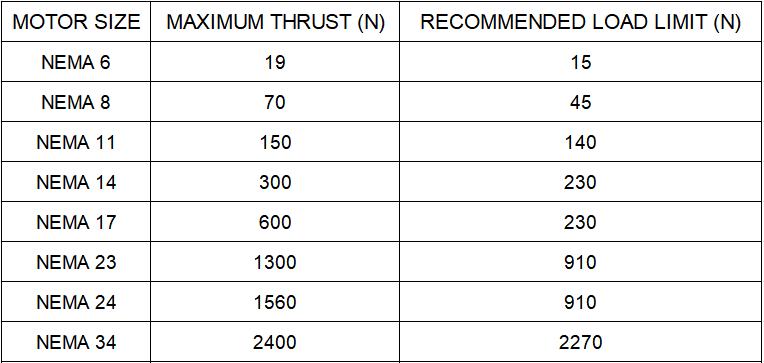
The table below shows the maximum supported thrust for each linear stepper motor series. The motor frame size can be determined based on the required thrust. Please note: The values in the table are nominal and provided for reference only. If you have specific thrust requirements, our engineering team can provide a customized solution.
- Motor Linear Running Speed Selection
The running speed of a linear stepper motor is closely related to the lead of the screw. When the screw completes one full revolution, the nut advances by one lead distance. In general, a lower speed is selected for a screw with a small lead, and a higher speed is selected for a screw with a large lead. The lead also determines the available thrust, so the following two points should be noted:
Large lead: Lower thrust, faster speed; Small lead: Higher thrust, slower speed.
- Effective Stroke
The effective stroke is the maximum distance the nut can travel along the linear axis of the screw.
- Driver Selection
Selecting a driver for a linear stepper motor follows the same process as selecting a stepper motor driver, because a linear stepper motor is essentially a combination of a stepper motor and a lead screw. Therefore, after determining whether the motor is open-loop or closed-loop, you can select a driver based on the current and voltage ratings of the linear stepper motor. As long as the motor's current and voltage fall within the driver's rated range, the driver will be compatible.