PUL/DIR mode is known as "Single Pulse Mode," while CW/CCW mode is referred to as "Dual Pulse Mode." These modes are typically switched via a set of DIP switches on the drive. Below is a detailed explanation.

Models supporting dual pulse mode include all closed-loop pulse stepper drives, as well as the DM860T and DM860Y.
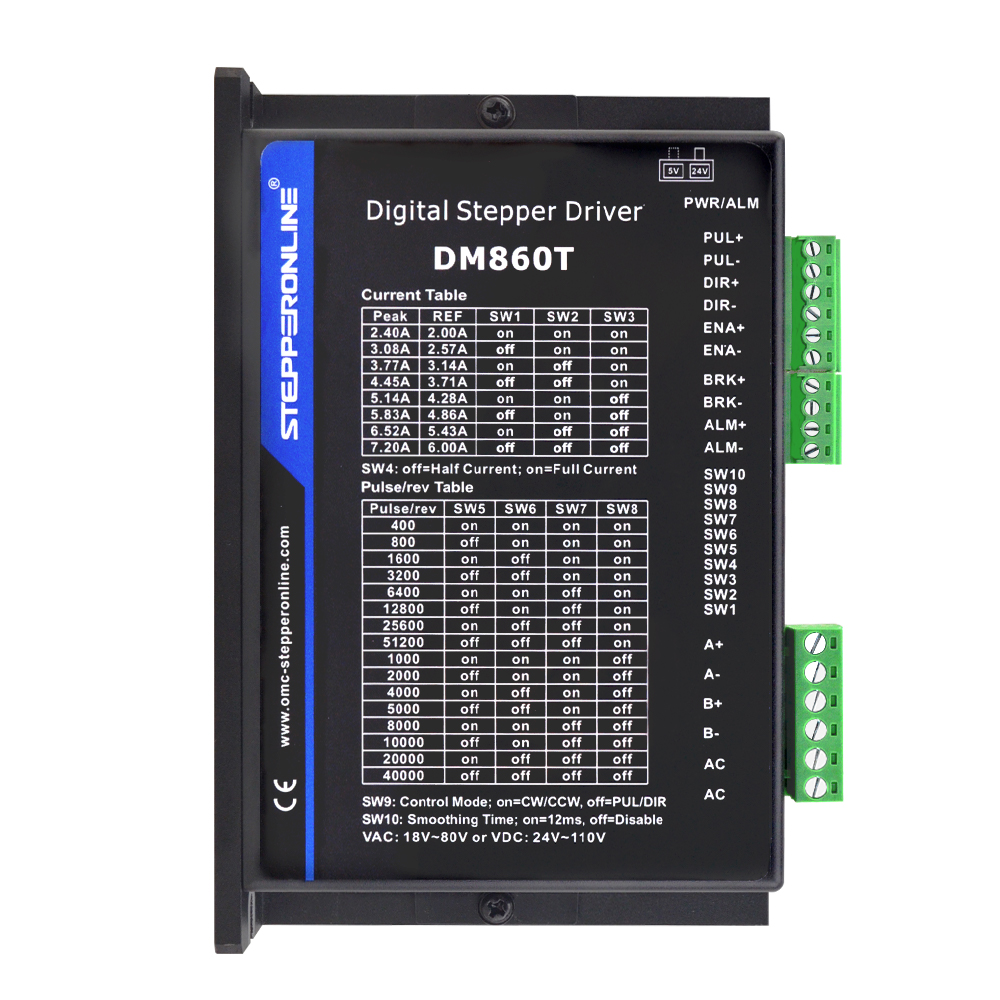
1. PUL/DIR Mode (Pulse + Direction)
This is the most commonly used and standard mode.
- PUL (or PULSE): Pulse signal terminal.
Each pulse edge (rising or falling, configurable via DIP switch) commands the motor to advance one step or microstep. This terminal controls the stepping motion of the motor.
- DIR: Direction signal terminal.
This is a level signal. A high level typically represents one direction (e.g., forward), while a low level represents the other direction (e.g., reverse).
How It Works: The controller sets the DIR terminal to high or low before sending the pulse sequence, thereby determining the motor's rotation direction. Subsequent PUL pulses will drive the motor in this preset direction.
Advantages:
- Wide compatibility
- Efficient use of controller resources (only one pulse output channel required)
- Intuitive programming logic
2. CW/CCW Mode (Forward Pulse + Reverse Pulse)
- CW (Clockwise): Clockwise pulse signal terminal. Each pulse sent to this port drives the motor one step clockwise.
- CCW (Counterclockwise): Counterclockwise pulse signal terminal. Each pulse sent to this port drives the motor one step counterclockwise.
How It Works:
- When forward rotation (CW) is required, the controller sends pulses only to the CW port, while the CCW port remains at a low level or receives no pulses.
- When reverse rotation (CCW) is required, the controller sends pulses only to the CCW port, while the CW port remains at a low level or receives no pulses.
Note: On most drives, the CW terminal shares the physical interface with the PUL terminal, and the CCW terminal shares the physical interface with the DIR terminal. This is why they represent two different control schemes for the same pair of interfaces.
Advantages:
- Simpler and more direct logic: To rotate in a specific direction, simply send pulses to the corresponding signal line—no need to preset the direction level.
- Better noise immunity: The direction information is encoded in the pulse signal itself, completely avoiding accidental directional errors caused by DIR signal jitter or timing issues.