When reviewing stepper motor specifications, you will notice that power is not listed as a parameter. Instead, motor selection is based on torque at a given speed rather than power.
The reason power (W) is not specified is that stepper motors do not have a defined "rated speed."
For AC motors and servo motors, the stated power (W) typically refers to the motor's output at its rated speed—commonly known as "rated power." Stepper motors, however, typically operate across a wide speed range, so their output power varies with speed. The calculated power (W) will differ depending on the speed used in the formula. Therefore, power is not used as a selection criterion for stepper motors; torque is the primary metric.
If you wish to estimate a stepper motor's output power, the torque-to-power conversion formulas are as follows:
P = ω · T
ω = 2π · n / 60
P = 2π · n · T / 60 ≈ 0.1047 × n × T
Where:
- P — Power, unit: Watt (W)
- ω — Angular velocity, unit: radians per second (rad/s)
- n — Rotational speed, unit: rpm
- T — Torque, unit: Newton-meter (N·m)
Consider the stepper motor 34HS31-6004S as an example, as shown below:
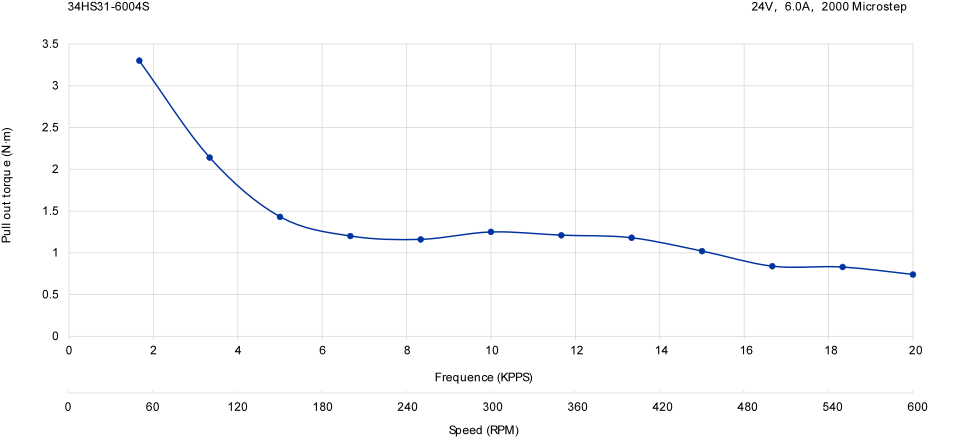
According to the torque curve, at a rotational speed of 300 RPM, the torque is 1.25 N·m. Substituting these values into the formula:
P = 0.1047 × n × T = 0.1047 × 300 × 1.25 = 39.26 W (no safety factor applied)
This means that when using the DM860T driver with a supply voltage of 24 VDC, a driving current of 6.0 A, and a microstepping setting of 2000 pulses/revolution, the estimated mechanical output power of the 34HS31-6004S at 300 RPM is approximately 39.26 W.
Note: This value applies only at this specific operating point. Always apply an appropriate safety factor and verify performance under actual operating conditions.