This article describes the characteristics of the three common control modes for AC servo motors and their typical application scenarios.
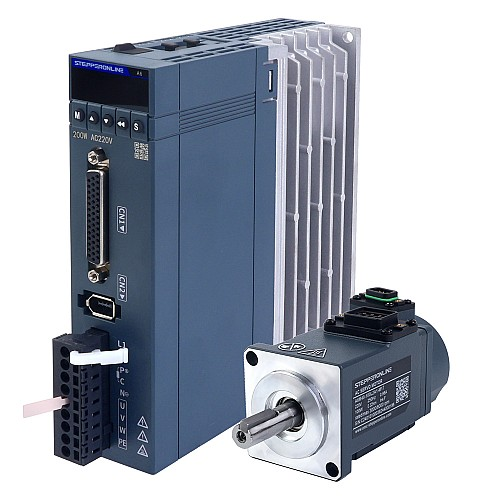
The three control modes are: position mode, torque mode, and speed mode.
1. Position Mode
Position mode is typically selected for applications with high positional accuracy requirements. The host controller controls the servo motor by sending pulse and direction signals to achieve precise positioning and forward/reverse rotation. This is the most commonly used control mode.
In this mode, how does the PLC control the servo motor? The T6/A6 series pulse version determines the rotation speed based on the pulse frequency and the rotation angle based on the number of pulses sent. Additionally, the T6/A6 series supports direct assignment of speed and displacement values via Modbus communication.
Common applications: Since position mode provides precise control over both speed and position, it is generally used in devices that require accurate positioning, such as linear modules, CNC machine tools, and printing machinery.
2. Torque Mode
Torque mode is suitable for applications where there are no specific requirements for motor speed or position, and only a constant torque output is needed. Unlike position mode, torque control mode sets the motor shaft output torque via an external analog input signal or by directly writing to the corresponding parameter register via communication.
Assume the motor output torque is set to 2.5 Nm. If the load torque on the motor shaft is less than 2.5 Nm, the motor will rotate in the set direction. When the load torque exceeds 2.5 Nm, the motor will be back-driven by the load and rotate in the opposite direction. When the load torque equals 2.5 Nm, the motor reaches equilibrium and maintains its current state (stationary or moving at constant speed, depending on prior conditions).
Common applications: This mode is generally used in winding and unwinding equipment that requires precise tension control on the material. For example, in a winding device or fiber drawing equipment, the torque setting must be adjusted according to changes in the winding radius to ensure that the material tension remains constant as the radius changes.
3. Speed Mode
In speed mode, the servo drive does not perform position control internally. To achieve positioning, the motor position signal or load position signal must be fed back to the host controller, which then performs the necessary calculations and control.
Common application scenarios: Uniform speed control of conveyor belts; smooth transport of components on automated assembly lines.