What Is the Purpose of a Termination Resistor?
Electrically, when an RS-485 signal encounters an impedance mismatch at the end of a cable, signal reflection occurs. The reflected signal superimposes onto the original signal, causing waveform distortion (ringing). This leads to data transmission errors, which may manifest as sporadic non-responsiveness, positional anomalies, or communication interruptions in the stepper drive.
A termination resistor acts as an "energy absorber" connected between the signal lines (A+ and B−). Its primary function is impedance matching: it absorbs signal energy at the endpoint of the transmission line, thereby eliminating signal reflection. This ensures a clean waveform and accurate data transmission. In high-speed communication scenarios, eliminating reflection also enables the system to operate stably at higher baud rates.
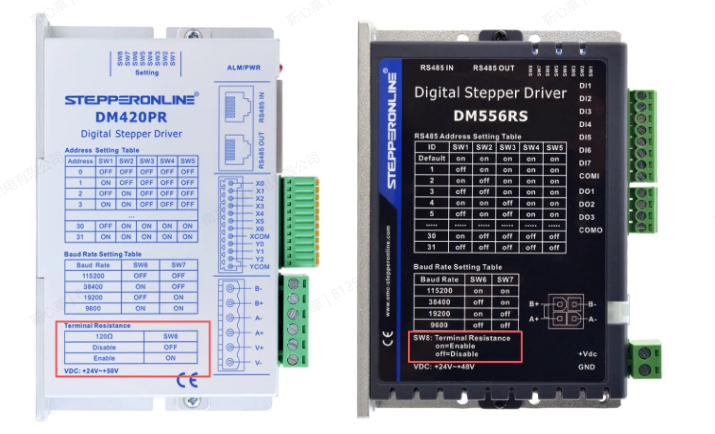
Most commercially available MODBUS RS-485-compatible stepper drives feature a built-in termination resistor that can be enabled via a DIP switch (e.g., SW8). Taking the DM420PR and DM556PR as examples, the termination resistor is enabled at the position marked in red in the diagram below.
Point-to-Point Connection: Termination Resistor Not Required
- Scenario: A single RS-485 port on the controller is connected to only one stepper drive, and the connecting cable is very short (e.g., less than 1 meter).
- Reason: In this dedicated, short-distance connection, signal transmission delay is minimal and the impact of reflection is negligible. Adding a termination resistor in this case unnecessarily increases the load on the driver.
Bus Topology Connection: Termination Resistors Required at Both Ends
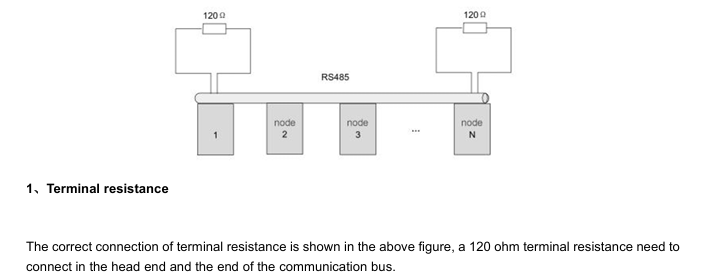
- Scenario: A single RS-485 port on the controller connects to multiple stepper drives in a daisy-chain configuration via a single trunk cable, forming a bus network.
- Reason: The signal must travel a long distance along the bus, and each drive node introduces a slight impedance discontinuity. At the physically farthest end of the bus, significant signal reflection occurs. This reflected signal travels back along the bus, interfering with communication across the entire network.