When selecting a power supply, it is generally recommended to choose one with adequate voltage, current, and power ratings. However, in certain applications—such as when the voltage or current required by the load exceeds the capacity of a single available power supply—it may be necessary to connect multiple power supplies in series or parallel to meet the load requirements. That said, connecting power supplies in series or parallel is not as simple as wiring them together. Several important precautions must be observed.
1. Series Connection
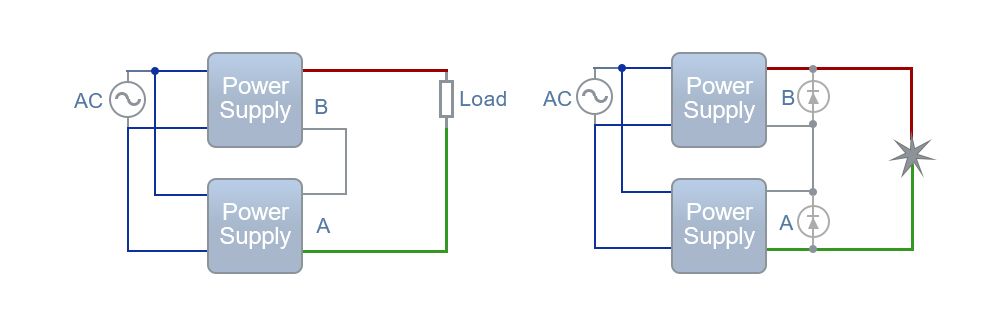
Series connection is typically used to combine lower-voltage power supplies to achieve a higher output voltage. When connecting power supplies in series, observe the following:
- The power supplies connected in series must be isolated power supplies, meaning the positive and negative output terminals are floating and electrically isolated from ground.
- The total output voltage after series connection must not exceed the isolation voltage rating of any individual power supply.
- Power supplies with different voltage ratings can be connected in series; however, it is recommended that their rated currents be the same. Otherwise, the maximum output current of the series circuit must not exceed the lowest rated current among the connected units.
- It is recommended to add diodes in the series circuit to prevent reverse current from damaging the power supplies.
2. Parallel Connection
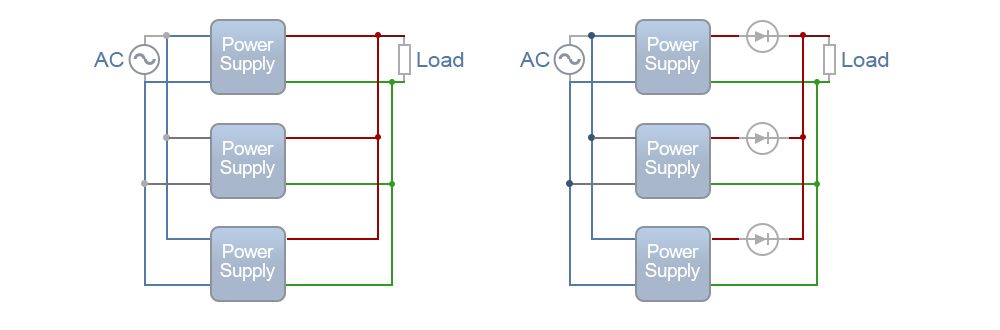
- The power supplies connected in parallel must be of the same model and specifications to ensure identical output voltages and compatible internal circuits. Mismatched output voltages can create a potential difference between units, causing excessive current flow that may damage the power supplies.
- When connecting power supplies in parallel, implement current-sharing control to balance the output current of each unit. This prevents uneven load distribution, which could cause one or more power supplies to overcurrent and fail.
- Even power supplies of the same model and specifications may have slight output voltage differences. Therefore, it is recommended to connect a diode in series at the output of each power supply to prevent reverse current from flowing back into and damaging the units.
Summary
Power supplies can be operated in series or parallel configurations, but doing so imposes specific requirements on power supply selection and circuit design.
Additionally, connecting power supplies in series or parallel is recommended only for short-term or temporary use. For long-term operation, it is advisable to replace the setup with a single power supply whose voltage and current ratings fully meet the application requirements.