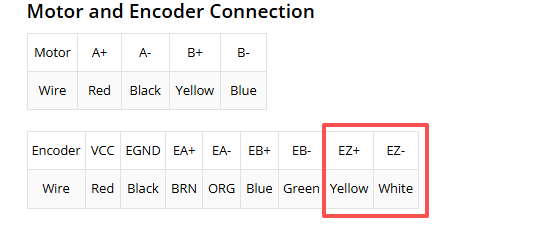
The core function of the Z signal is to provide a unique absolute position reference point once per revolution. It acts as a mechanical home position: for every full rotation of the motor shaft, the Z signal outputs one pulse. For detailed encoder channel descriptions, refer to the product documentation on the StepperOnline website.
Stepper motor with Z signal:
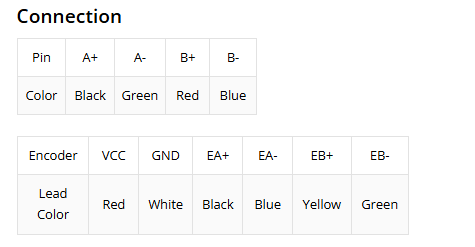
Stepper motor without Z signal:
Situations where the Z signal is typically NOT required:
- Speed Control Mode: If you are only using the motor for speed control and are not concerned with absolute position, only channels A and B are needed for speed feedback.
- Relative Position Control: If all movements are relative to the current position after power-on, with no need to reference an absolute mechanical coordinate. For example, a simple push mechanism that performs reciprocating motion with a fixed stroke, where the starting point is arbitrary.
- System Already Has Other Homing Methods: If your equipment is already equipped with reliable home-position sensors (such as limit switches) and performs a homing routine after each startup, the Z signal is not necessary. Homing with an external sensor is often more precise and reliable than using the Z signal, because the Z signal only indicates the motor shaft's position, while an external sensor can directly detect the load's position.
Situations where the Z signal IS required:
- Strict Multi-Axis Synchronization: In multi-axis systems that require precise synchronization of all axes at the start of each revolution. The Z signal can provide a common synchronization point for multiple motors.
- Preventing Multi-Revolution Cumulative Error: In applications requiring long-term continuous operation where any position error accumulation is unacceptable, the Z signal can serve as a per-revolution position reference to correct cumulative error.
- As a Precise Intra-Revolution Home Position: When the operational home position of the load directly driven by the motor aligns with the Z signal position of the motor shaft, the Z signal can be used as a very precise and highly repeatable home signal, eliminating the need for an external sensor.
Summary: For most conventional closed-loop stepper applications, it is entirely feasible to omit the Z signal, provided you can accept that the system needs to perform a homing operation after each power-on to establish an absolute coordinate system. Decide whether to use it based on your specific application's requirements for establishing a home position upon power-up. During wiring, you only need to correctly connect the encoder's A, A-, B, and B- signal lines to the driver; the Z and Z- lines can be left unconnected. Note that omitting the Z signal does not affect speed-loop performance but removes the per-revolution absolute reference. Please confirm compatibility in your driver's manual.