The resolution of an encoder is typically measured in bits and represents the smallest change the encoder can detect.
STEPPERONLINE's T6 servo motors are currently available with 17-bit and 23-bit encoders. This article explains the differences between these two encoder types and covers the working principles of multi-turn absolute encoders as well as the definition of multi-turn functionality.
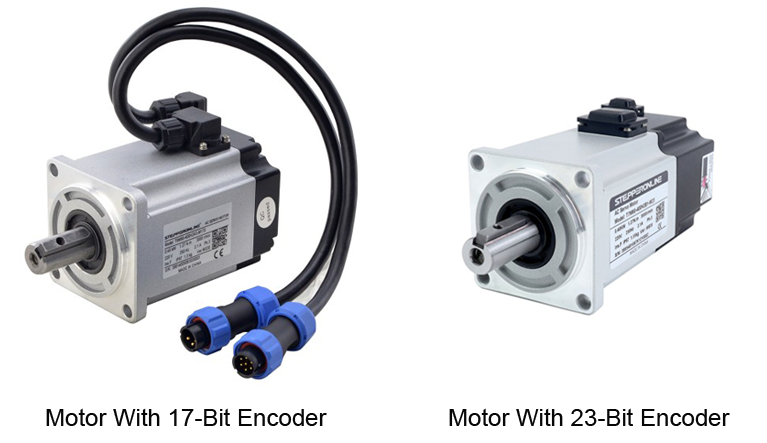
1. Encoder Resolution
Encoder resolution determines detection accuracy. The higher the resolution, the smaller the displacement or angular change the encoder can detect. Specifically:
- 17-bit encoder: Represents 2^17 distinct positions, or 131,072 positions per revolution.
- 23-bit encoder: Represents 2^23 distinct positions, or 8,388,608 positions per revolution.
Therefore, a 23-bit encoder offers significantly higher resolution than a 17-bit encoder, delivering greater accuracy and finer displacement detection.
2. Single-Turn and Multi-Turn Absolute Encoder Principles
The 17-bit encoder supports single-turn operation only, while the 23-bit encoder supports both single-turn and multi-turn functionality.
A multi-turn absolute encoder records not only the position within a single revolution but also the cumulative position across multiple revolutions. Here is how each type works:
Single-turn absolute encoder: Using optical, magnetic, or capacitive sensing methods, the encoder assigns a unique code to every position within one revolution. This allows the encoder to report the current absolute position immediately upon power-up, even after a power cycle.
Multi-turn absolute encoder: Building on the single-turn design, this encoder additionally tracks the number of complete revolutions, typically through a gear mechanism. As a result, it records both the angular position within the current revolution and the total number of revolutions from the starting point to the current position.
With absolute position information, the system can determine position without requiring a homing reference. Even if the power supply is interrupted or affected by external interference, the exact position is fully retained and available upon power restoration.
3. Application Differences Between 17-Bit and 23-Bit Encoders
Due to differences in resolution and position-recording capabilities, 17-bit and 23-bit encoders are suited to different application scenarios:
- 17-bit encoder: Suitable for applications that require good accuracy but not extreme resolution, such as medium-precision machine tools and general industrial automation equipment.
- 23-bit encoder: Suitable for applications that demand very high precision and fine displacement detection, such as high-precision CNC machine tools, precision measuring instruments, and robotic joint position feedback.