The RMS Current and the Peak Current are two different ways of expressing the same electrical current that flows through a stepper motor. The difference between them lies in how the current is measured and calculated.
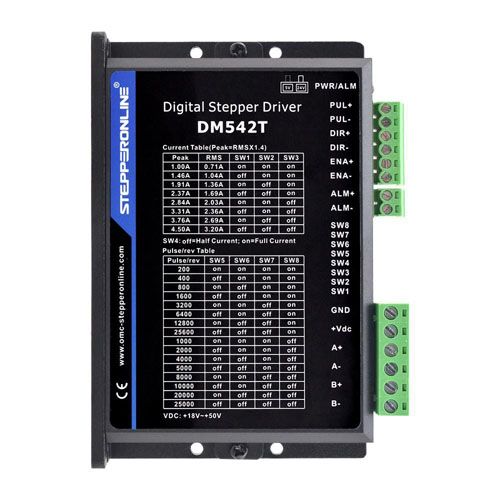
RMS Current
The RMS (Root Mean Square) current is a measure of the effective current that flows through the motor coils over time. It represents the equivalent DC current value that would produce the same heating effect in the motor windings. The RMS current is calculated by taking the square root of the average of the squared current values over one complete electrical cycle.
For a sinusoidal current waveform, the relationship between RMS current and peak current is:
I_RMS = I_Peak / √2 ≈ I_Peak / 1.414
Peak Current
The peak current is the maximum instantaneous current that flows through the motor coils within each electrical cycle. In microstepping drivers, the current waveform is typically sinusoidal, and the peak current represents the amplitude of that waveform. It is not limited to motor start-up or stop conditions; it occurs continuously during normal operation.
Power Dissipation
The power dissipated (copper loss) by the motor coils is calculated based on the RMS current, not the peak current:
P = I_RMS² × R
where R is the winding resistance. This is why the RMS current is critical for thermal management—it directly determines how much heat the motor generates.
Setting the Current on the Driver
In general, the RMS current is used to specify the rated current of a stepper motor. When setting the current on the driver, you should match the driver's output to the motor's rated RMS current to ensure safe, continuous operation without overheating.
Some stepper motor drivers are calibrated in peak current rather than RMS current. If your driver uses peak current settings, you must convert the motor's rated RMS current to the equivalent peak value:
I_Peak = I_RMS × √2 ≈ I_RMS × 1.414
Example
Suppose a stepper motor has a rated current of 2.0 A RMS.
- If the driver is calibrated in RMS current, set the driver to 2.0 A.
- If the driver is calibrated in peak current, set the driver to 2.0 × 1.414 ≈ 2.83 A.
Setting the peak current to 2.0 A on a peak-calibrated driver would result in an actual RMS current of only about 1.41 A, which would underperform the motor. Conversely, setting an RMS-rated driver to 2.83 A when the motor is rated for 2.0 A RMS would cause excessive heating and potential damage.
Recommendations
-
Always match the driver's RMS output to the motor's rated RMS current for continuous or long-duration operation. This ensures the motor operates within its thermal limits.
-
If the driver is calibrated in peak current, convert the motor's rated RMS current to peak using the formula above (multiply by 1.414) before setting the driver.
-
Monitor motor temperature during extended operation. If the motor temperature is higher than acceptable, reduce the current setting on the driver accordingly.
-
For short-duty-cycle applications, you may temporarily increase the current above the rated RMS value to achieve higher torque, but ensure the average RMS current over time does not exceed the motor's rating to prevent overheating.