- Locking Mechanism of Planetary Gearboxes
Some customers may have concerns about potential loosening between our full-round input bore gearboxes and D-flat stepper motor shafts due to insufficient locking force. This section explains why our design prevents such issues through two key aspects.
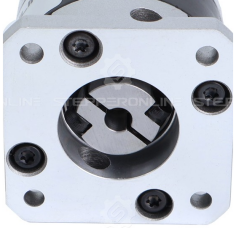
1.1. Clamping Design at Gearbox Input
-
Full-round Bore with Radial Clamping
-
Principle: The coupling features a complete circular bore. Lateral fastening screws induce elastic deformation for 360° uniform contraction, ensuring full-shaft grip.
-
Screw Configuration: Dual symmetrical screws create balanced clamping forces to prevent stress concentration and enhance vibration resistance.
-
D-flat Shaft Adaptation: The clamping force is distributed as contact pressure on the flat surface while maintaining frictional grip on the curved sections, providing redundant anti-rotation protection.
1.2. Torque Capacity
Although the gearbox output end delivers higher torque, the motor–gearbox interface only transmits the motor's output torque—a relatively low value. Our radial clamping design reliably handles this torque without slippage.
Conclusion: Properly tightened connections will not loosen under high torque. Advantages include:
Minimized shaft damage (no set screw marks)
Keyless alignment
Rapid assembly
No need for periodic screw retightening
- Torque Specifications of Planetary Gearboxes
2.1. Two Critical Torque Ratings
Gearbox torque capacity is limited by gear and housing strength, and is defined by:
-
Maximum Continuous Torque: The safe long-term operational limit.
-
Instantaneous Peak Torque: The short-term overload threshold designed to protect against damage.
2.2. Why High-Ratio Gearboxes Have Lower Torque Limits
Example: The EG17-G5 (5:1) allows 10 Nm, while the EG17-G10 (10:1) permits only 5 Nm.
Technical Reasons:
2.2.1. Gear Size
High-ratio designs use smaller input gears (fewer teeth, reduced module) to drive larger output gears.
2.2.2. Root Bending Stress
Bending stress is approximately proportional to: applied force / (gear module² × geometric factors).
For a given input torque, smaller input gears experience higher root stress due to their reduced cross-sectional area and lower bending resistance.
2.2.3. Contact (Hertz) Stress
Contact stress is approximately proportional to: √(force) / √(curvature radius).
Smaller input gears exhibit higher contact stress due to their tighter curvature.
2.2.4. Input Shaft & Bearing Limits
High-ratio gearboxes employ thinner input shafts and smaller bearings with lower torsional and load ratings.
Summary
This article details the technical advantages of our full-round bore planetary gearboxes in terms of locking reliability and torque performance. The patented clamping mechanism (360° uniform contraction + dual-screw balance) ensures secure motor-shaft coupling while simplifying assembly. Clear torque ratings and rigorous stress analysis validate the design's robustness across all gear ratios, ensuring long-term durability under diverse operating conditions.