When using a stepper motor, you need a power supply to drive it. The right power supply ensures your stepper motor operates at peak performance, while an incorrect power supply may result in poor performance or excessive energy waste.
Below are a few tips for choosing a power supply:
-
Confirm the motor's rated current. You can find this value in the motor datasheet.
-
Confirm the supply voltage. Supply voltage is the main factor when choosing a power supply. Generally, a higher supply voltage improves motor performance (e.g., faster response and higher torque at speed). However, the voltage must not exceed the maximum input voltage rating of your stepper motor driver.
The table below shows the recommended supply voltages for stepper motors. Choose the appropriate voltage based on your application requirements.
| Motor Size | Supply Voltage |
|---|---|
| NEMA 8 – NEMA 17 | 12 – 24 VDC |
| NEMA 23, NEMA 24 | 24 – 48 VDC |
| NEMA 34 | 36 – 60 VDC / 30 – 70 VAC |
| NEMA 42 – NEMA 52 | 60 – 100 VDC / 110 – 220 VAC |
- Calculate the required power. We provide a simple formula for you: P = n × I × V × 1.2
Where:
-
P = Total power (W)
-
n = Number of stepper motors
-
I = Motor rated current (A)
-
V = Supply voltage (V)
-
1.2 = 20% safety margin
Example: For 3 motors, each with a rated current of 3 A and a supply voltage of 36 V:
P = 3 × 3 A × 36 V × 1.2 = 388.8 W
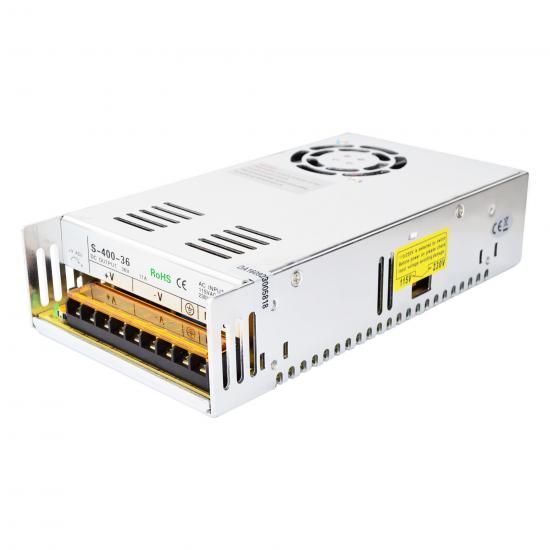
In this case, a 36 V, 400 W power supply would be suitable.
Please note that this formula provides only an estimate of power, and different operating conditions will require different power levels.
For example, in a 3-axis system, not all three motors operate simultaneously, and not all three motors operate at maximum load. In such cases, the required power may be lower than the value calculated by the formula.
If you need assistance, the StepperOnline support team can recommend suitable drivers and power supplies for your application.