To clearly define the technical characteristics of STEPPERONLINE's T-Series, Y-Series, and the new TE-Series drives, we will analyze them based on the core difference in drive technology: open-loop versus closed-loop control systems. The comparison focuses on the following three key aspects: basic drive configuration, torque performance, and operating temperature and noise.
● Open-Loop Drives
Basic Drive Configuration
T-Series:
- Supports 5 V / 24 V control signals, selectable via the DIP switch on the top of the drive.
- Offers multiple selectable microstep resolutions to accommodate different resolution requirements.
- Supports Pulse/Direction/Enable control signal inputs and features an external alarm signal input port.
- The DM860T model supports Pulse/Direction and CW/CCW pulse modes, selectable via a DIP switch.
TE-Series:
- Supports 5–24 V control signals automatically; no manual switching required.
- Offers multiple selectable microstep resolutions to accommodate different resolution requirements.
- Supports Pulse/Direction/Enable control signal inputs (only the DM860TE model includes an external alarm signal input port).
- The DM860TE model includes an RS232 interface, allowing parameter configuration and testing via dedicated software.
- Features motor winding open-circuit detection.
Y-Series:
- Supports 5–24 V control signals automatically; no manual switching required.
- Offers multiple selectable microstep resolutions to accommodate different resolution requirements.
- Supports Pulse/Direction/Enable control signal inputs.
- The DM860Y model supports Pulse/Direction and CW/CCW pulse modes, selectable via a DIP switch.
Torque Performance
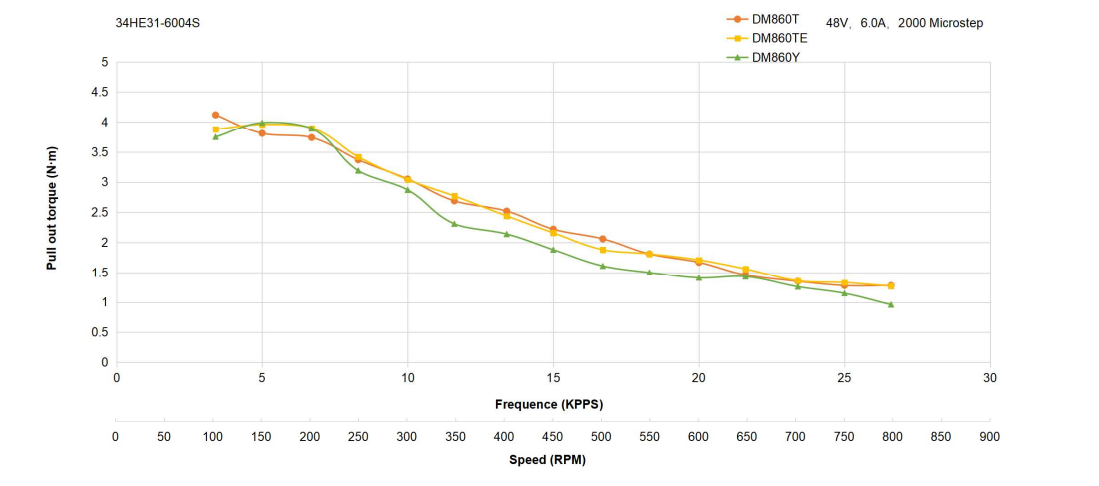
Based on the torque curves, the T-Series, TE-Series, and Y-Series exhibit similar torque characteristics. The Y-Series drive delivers slightly lower torque than the other two series at medium to high speeds, but offers a marginal advantage at low speeds.
Operating Temperature and Noise
The operating temperature and noise levels are very similar across all three series. Small to medium-sized stepper drives without cooling fans operate with minimal noise and maintain a relatively low surface temperature. Larger drives equipped with cooling fans generate more noise due to fan operation; however, their surface temperature remains within a moderate range.
● Closed-Loop Drives
1. Basic Drive Configuration
T-Series:
- Adjust output current via the external S1 potentiometer or via software.
- Supports 5 V / 24 V control signals, selectable via the top DIP switch.
- Supports electromagnetic brake control signal input.
- Defaults to a 1000-line encoder; configurable via software to support encoder resolutions from 500 to 5000 lines.
- Supports Pulse/Direction and CW/CCW pulse modes, selectable via a DIP switch.
TE-Series:
- Automatic current tuning based on motor parameters; no manual potentiometer adjustment required. Motor parameters are configurable via software.
- Supports 5–24 V control signals automatically; no manual switching required.
- Supports electromagnetic brake control signal input.
- Defaults to a 1000-line encoder; configurable via software to support encoder resolutions from 500 to 5000 lines.
Y-Series:
- Automatic current tuning based on motor parameters; no manual potentiometer adjustment required. Motor parameters are configurable via software.
- Supports 5–24 V control signals automatically; no manual switching required.
- Does not support electromagnetic brake control signal input.
- Defaults to a 1000-line encoder; configurable via software to support 1000-line, 2500-line, or 5000-line encoder resolutions.
- Supports Pulse/Direction and CW/CCW pulse modes, selectable via a DIP switch.
Torque Performance
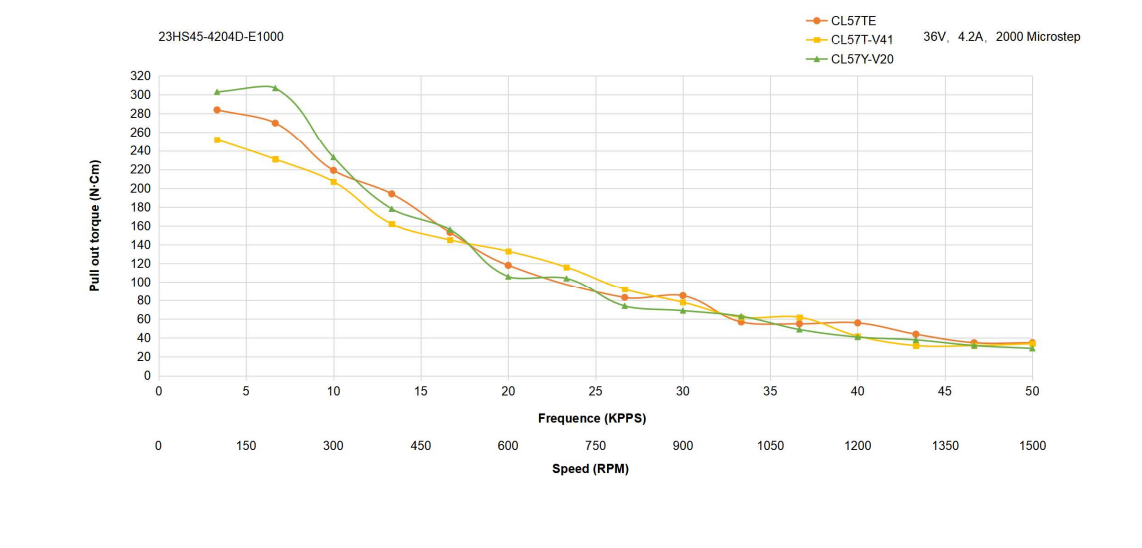
The T-Series drive exhibits a relatively flat torque curve, with motor torque decreasing more gradually as speed increases. The TE-Series drive has a slightly steeper torque curve, providing higher torque at low speeds but reduced performance at high speeds. The Y-Series drive has a steeper torque curve, where motor torque decreases more noticeably as speed increases, but it offers the highest low-speed torque among the three.
Operating Temperature and Noise
The operating temperature and noise levels are very similar across all three series. Small and medium-sized stepper drives without cooling fans operate with very low noise and maintain a relatively low surface temperature. Larger drives equipped with cooling fans generate more noise due to fan operation; however, their surface temperature remains within a moderate range.
In summary, each of the three drive series has its own advantages. You can select the most suitable drive based on your specific application requirements. If you have any further questions, please feel free to contact us.